Richardson drainage contractor and French drain evaluation
Drainage Company in Richardson, TX | French Drain Installation
Choose a drainage company in Richardson that evaluates runoff, mature landscaping, roof discharge, and saturated soil before French drain installation or another yard drainage solution. Schedule a free drainage evaluation.
A drainage company in Richardson should determine whether water is moving visibly across the lot, remaining within saturated soil, or arriving from a concentrated source. A creek-oriented neighborhood can still have a private low point blocked by beds or paving, and a narrow side yard may receive more roof water than its grade can carry. French drain installation is considered after surface runoff, downspouts, irrigation, and the available outlet are separated. The free drainage evaluation starts with that evidence.
Canyon Creek, Richardson Heights, Duck Creek-area neighborhoods, and eastern Richardson near CityLine include different housing forms, tree cover, paving, and responsibility boundaries. Greenbelts or public systems may provide geographic context without guaranteeing a direct or authorized connection from a residence. The current lot, not the neighborhood label, controls the plan.
Water management can intersect with settled concrete and foundation observations. A driveway or patio can redirect flow, while moisture near a wall can be important without proving structural movement. The same-city Richardson concrete and foundation pages create separate paths for those questions so a drainage contractor does not overstate what collection and conveyance can accomplish.
City-specific context
Richardson drainage planning connects private lots with mature landscapes and fixed downstream routes
Creek corridors, public features, and planned drainage do not replace a property-level review of roofs, grades, paving, barriers, and the final maintainable outlet.
01
Canyon Creek
Established homes can include mature trees, sloping yards, patios, pools, and public drainage context. Private collection should protect roots and utilities while confirming that any downstream route is physically workable and authorized.
02
Richardson Heights
Older blocks may have additions, converted garages, replacement drives, raised beds, and altered downspouts. The inspection identifies which improvement changed the water path rather than assuming the original lot grade still controls flow.
03
Duck Creek-area neighborhoods
Greenbelts and creek-related systems can be nearby, yet fences, walks, landscaping, and low concrete may interrupt water before it reaches a larger corridor. The private route must be traced from the house outward.
04
CityLine and eastern Richardson
Townhomes, denser paving, managed landscapes, common areas, and utility congestion can affect ownership and access. A proposal should distinguish private work from association or public features and avoid assuming shared discharge rights.
Method follows the water path
Richardson yard drainage solutions and drainage system installation
The selected response should capture the verified water, fit the available elevations, and remain observable and serviceable after landscaping is restored.
01
Surface grading and route restoration
Regrading can reopen shallow flow where foundation clearances and downstream elevation allow. Tree roots, beds, paving, utilities, and neighboring grade can limit the practical change.
Visible low points at lawns, drives, and patios may benefit from surface collection when inlet elevations, debris exposure, walking areas, and discharge are planned.
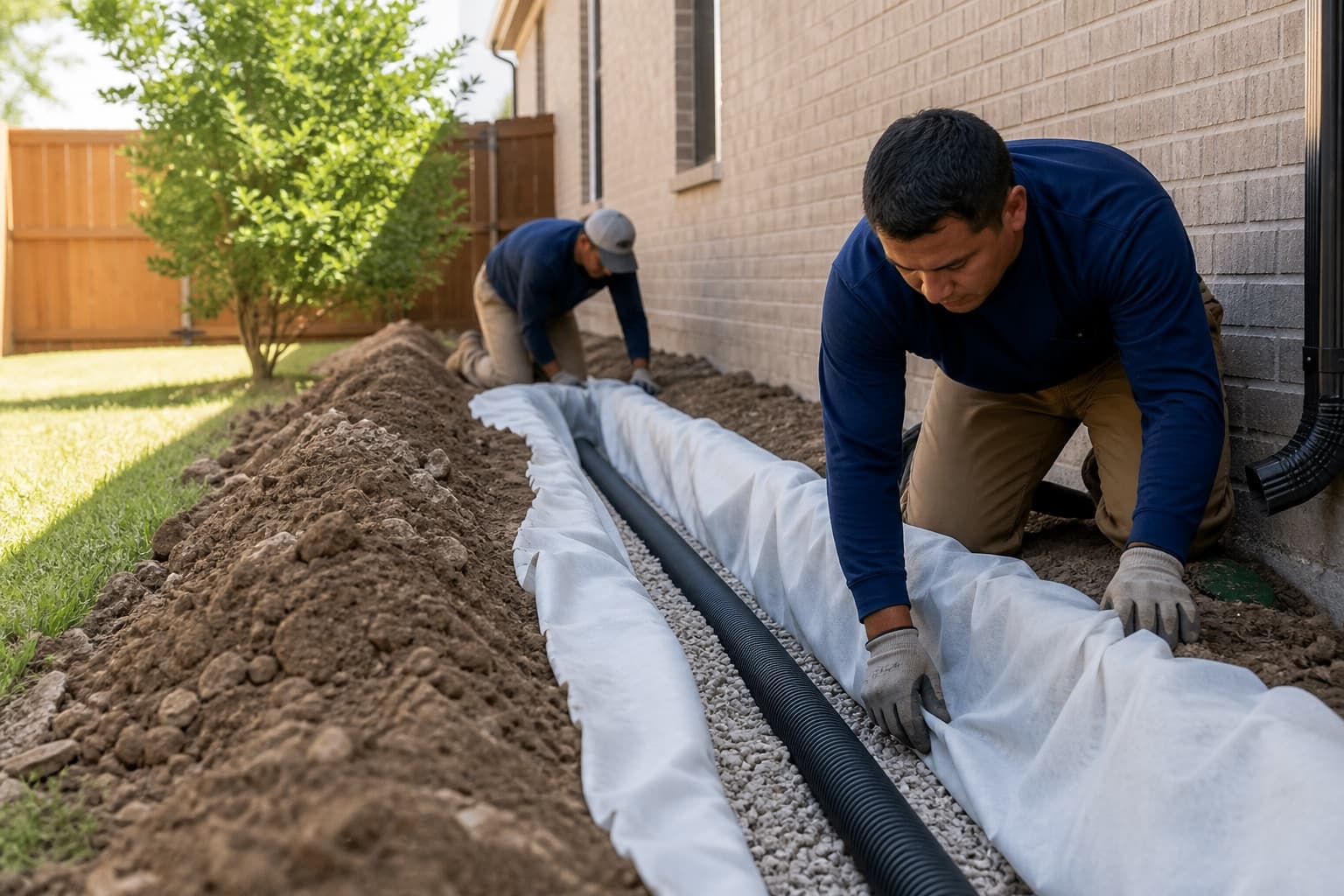
A perforated system can intercept water moving through soil along a confirmed route. Trench design, filter protection, roots, utilities, fall, and outlet determine feasibility.
When a lowered drive, walk, or patio controls the low point, compare drainage collection with the Richardson concrete leveling evaluation rather than forcing water around an unchanged slab.
French drain installation in Richardson: suitability and design limits
French drains collect subsurface moisture; they do not automatically correct roof runoff, a visible grading problem, or water trapped on top of concrete.
Confirm recurring soil saturation
The evaluation looks for a consistent wet route and separates it from short-lived surface ponding, irrigation, leaks, and downspout discharge before recommending perforated collection.
Protect roots and utilities
Mature trees and congested side yards can constrain trench alignment. Public marking, private utility information, irrigation, root protection, and access should be addressed before excavation.
Design the aggregate and filter assembly
Trench width, depth, pipe, washed aggregate, separation fabric, and surface restoration should support collection while limiting sediment migration and future clogging.
Establish a lawful outlet
A nearby creek, greenbelt, inlet, street, or shared feature is not automatically available. Elevation, ownership, authorization, erosion protection, and maintenance responsibility must be confirmed.
Keep the system serviceable
Cleanouts, an observable discharge point, debris management, and documented routing make future maintenance and troubleshooting more practical.
Richardson drainage repair problems to separate by source
Recurring water is evaluated by timing, weather, location, and its relationship to roofs, irrigation, paving, and downstream barriers.
Surface runoff collecting behind beds or edging
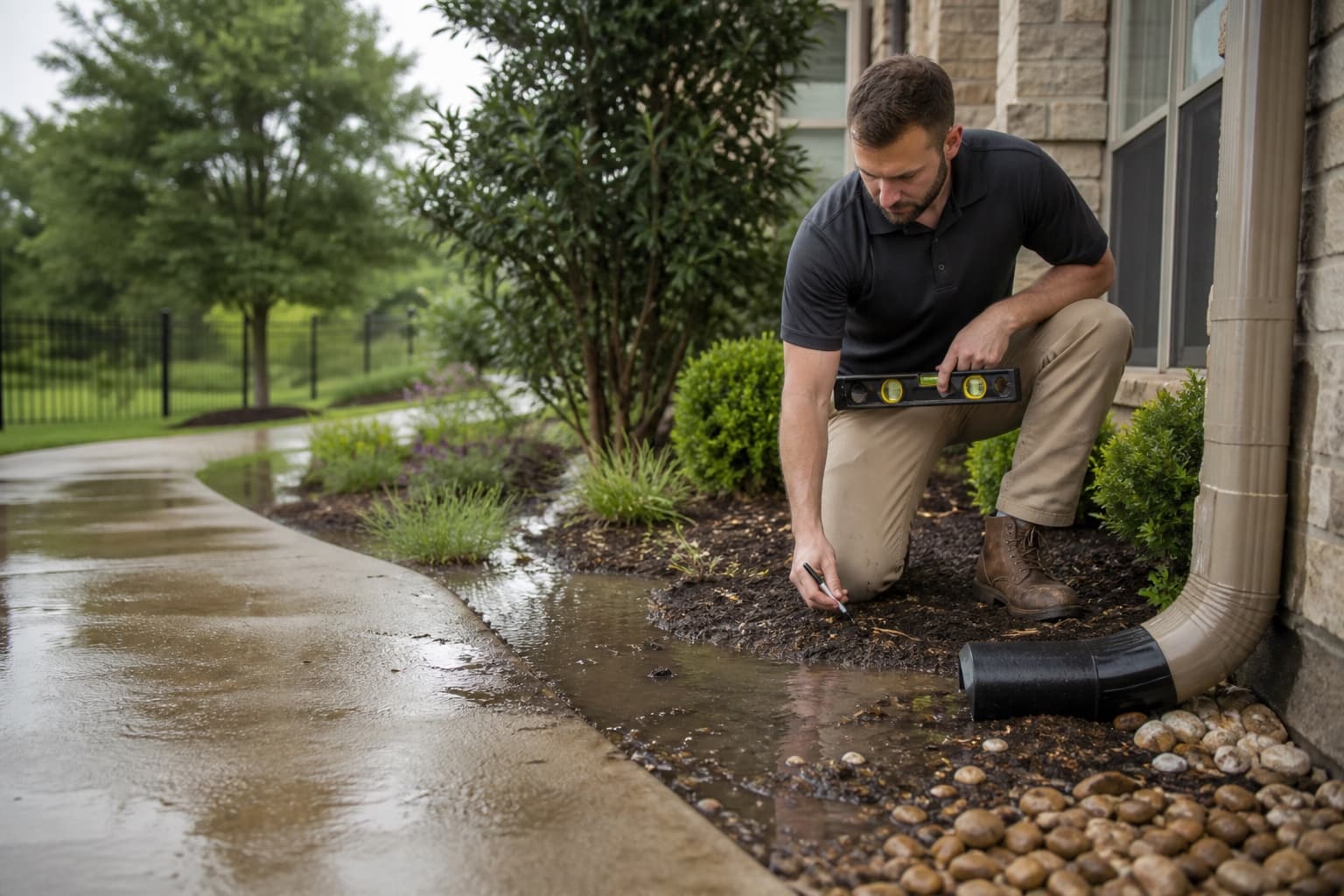
Raised soil, borders, and dense planting can block shallow flow. Where water is visible above grade, restoring surface movement or adding an inlet may be more direct than a subsurface trench.
Downspout concentration in narrow side yards
Several roof planes may discharge into a confined route containing fences, equipment, and utilities. Capacity, solid conveyance, cleanouts, fall, and discharge should be planned together.
Standing water beside drives and patios
Hardscape can shed water into a lawn low point or prevent it from leaving. Slab slope, landscape grade, inlets, and the next outlet determine whether drainage and concrete work should be coordinated.
Saturated soil on a shaded or downhill route
Persistent wetness can involve subsurface flow, overwatering, roof discharge, or limited drying. A French drain is evaluated only after those inputs and an achievable discharge elevation are understood.
Water present outside storm events
Irrigation, plumbing, pool systems, and condensate can create patterns unrelated to rain. Identifying those sources protects the homeowner from installing a stormwater system for the wrong problem.
Related, not interchangeable
Foundation drainage in Richardson without structural overstatement
Exterior water management can address an observed site condition. It cannot establish why a foundation moved or promise how the structure will perform.
Drainage evidence comes from water behavior
Ponding, erosion, downspout flow, soil saturation, and outlet performance define the drainage scope. Floor elevations and building distress define the separate foundation discussion.
Mature landscaping is context
Trees, beds, irrigation, and shade can affect moisture and access, but they should not be assigned as structural or drainage causes without property-specific evidence.
Concrete and walls can block surface routes
Walks, drives, patios, and retaining features may create enclosed low points. Their elevations are reviewed with collection options rather than treated as proof of a foundation concern.
Performance records remain separate
Drainage follow-up tracks capture, flow, outlet stability, erosion, and maintenance. Foundation monitoring uses structural observations, preserving honest service boundaries.
Richardson drainage system installation evaluation
A source-to-outlet map is developed before comparing grading, surface collection, solid conveyance, or French drain construction.
1
Establish when water appears
Storm intensity, ponding duration, irrigation schedules, emitter behavior, and dry-weather observations help classify the condition.
2
Trace contributing roofs and surfaces
Roof planes, downspouts, yards, drives, patios, neighboring grades, beds, and walls are mapped so the design accounts for the full contributing area.
3
Survey low points and constraints
Foundation clearance, inlet elevation, available fall, fences, equipment, roots, utilities, paving, and responsibility boundaries shape the route.
4
Compare maintainable alternatives
The contractor compares grading, swales, basins, solid pipe, French drains, and concrete coordination based on source and outlet rather than assuming one preferred system.
5
Define exclusions and follow-up
The written scope identifies collection, conveyance, discharge, restoration, maintenance, and any engineering, plumbing, pool, electrical, approval, or structural work left separate.
Property-specific scope
Richardson drainage and French drain cost considerations
Price depends on the measured route, access, utilities, collection method, outlet, and restoration. A free drainage evaluation supports a site-specific proposal rather than a standard neighborhood package.
Downspouts, surface basins, subsurface zones, and separate water sources can require different fittings, pipe, and maintenance access.
Excavation around roots and utilities
Mature landscaping, private lines, public utilities, narrow side yards, and equipment can change the route and amount of hand work.
Hardscape and finish restoration
Walks, patios, drives, walls, sod, beds, irrigation, and decorative finishes should be identified so restoration is priced or excluded clearly.
Discharge and third-party requirements
Outlet construction, erosion control, pumps, electrical service, association review, easements, permits, or public connections may affect cost and responsibility.
Before the visit
Prepare for a Richardson drainage evaluation
Water observations, site history, and responsibility information help focus the visit on the actual route.
01
Take safe photos of ponding, downspouts, patios, drive edges, side yards, inlets, and visible outlets during rain.
02
Note whether the condition also appears during irrigation, pool use, condensate discharge, plumbing use, or dry weather.
03
Gather dates for additions, converted garages, replacement paving, landscape walls, utilities, and drainage changes.
04
Identify known public, private, association, irrigation, and utility features along possible routes.
05
Clear access to visible emitters and cleanouts when safe without excavating or disturbing utilities.
Continue your research
Richardson drainage guides and nearby service areas
Use educational resources to prepare questions, then rely on property observations and measurements for the recommendation.
Is a French drain suitable for every Richardson wet yard?+
No. French drains address defined subsurface moisture. Visible runoff, roof discharge, irrigation, plumbing, a blocked surface route, or limited outlet fall may require another response.
Can water be discharged toward a greenbelt or creek?+
Do not assume so. Elevation, property boundaries, easements, public or association rules, erosion, and maintenance responsibility must be verified before relying on an off-lot feature.
Can mature trees prevent drainage installation?+
Roots can constrain excavation and route selection, but feasibility depends on the specific alignment, tree-protection needs, utilities, and available alternatives. The system should not be forced through an unsuitable corridor.
What if a patio causes the low point?+
Surface collection may be considered, and the patio elevation may deserve a separate concrete evaluation. Door thresholds, slope, drains, landscaping, and the downstream outlet should be reviewed together.
Does drainage correction guarantee foundation stability?+
No. It can manage an identified water condition, while structural performance depends on additional factors. Foundation observations should be evaluated and monitored separately.
How much does French drain installation cost in Richardson?+
Cost follows trench length and depth, aggregate and filter design, utilities, roots, access, outlet construction, crossings, and restoration. Suitability is confirmed before pricing.
What happens during a free drainage evaluation?+
The contractor reviews reported timing, visible water sources, grades, low points, hardscape, constraints, and possible outlets. Testing, engineering, approvals, and installation remain separate unless included in a proposal.
How are surface drains different from French drains?+
Surface drains capture visible ponding through inlets. French drains collect water within saturated soil through a filtered perforated system. Some properties need one, both, or neither after the source is identified.
Free drainage evaluation
Schedule a Free Drainage Evaluation in Richardson
Describe where water appears, when it occurs, and which roofs, landscaping, paving, utilities, or downstream features shape the route.