
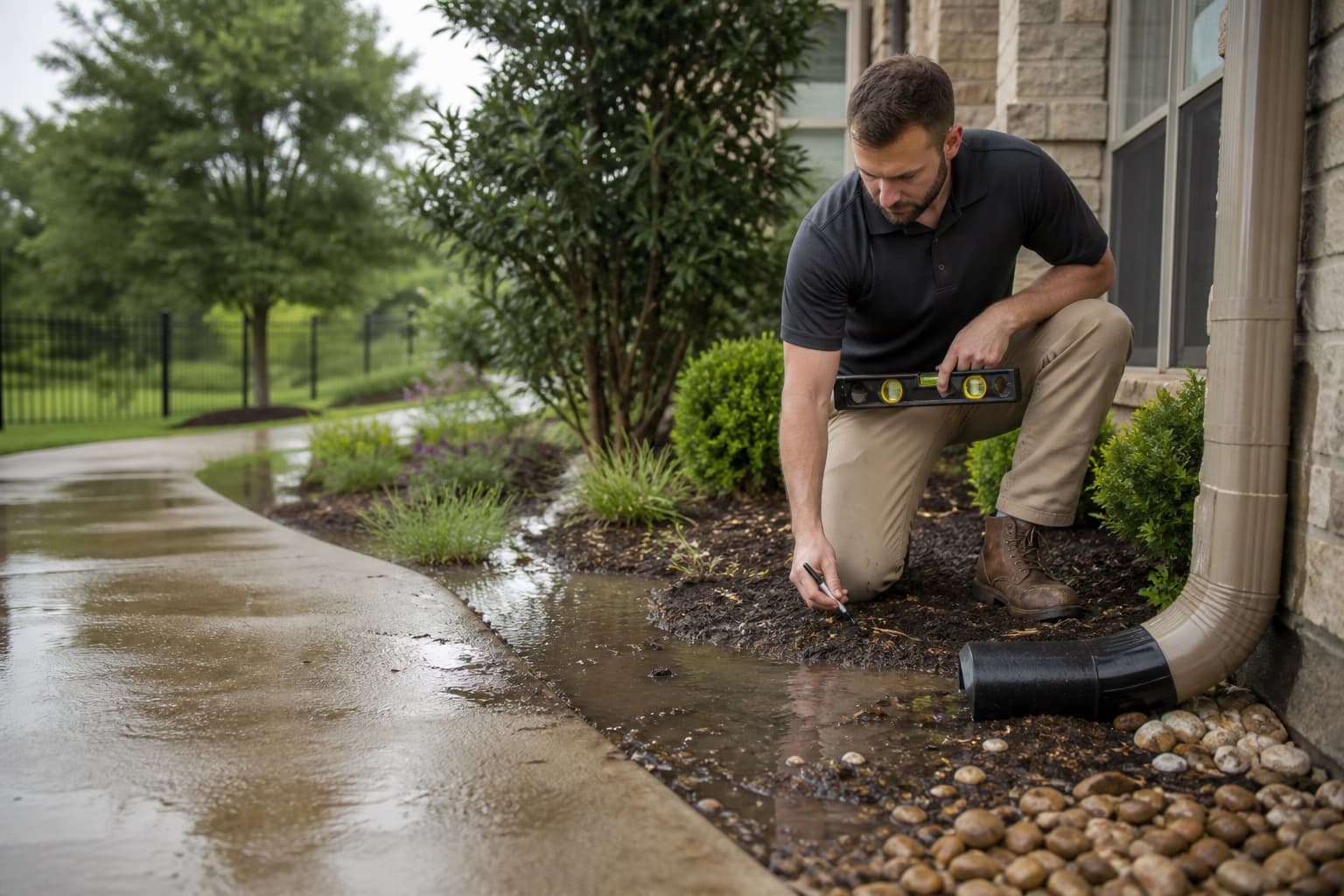
Roofs collect rainfall over a large surface and release it at valleys, gutters, and downspouts. When a downspout ends close to the building, a gutter leaks or overflows, or the ground directs discharge back toward the wall, water can concentrate near the foundation perimeter. That condition does not prove foundation movement, but it deserves evaluation as part of the property’s moisture pattern.
Follow the water from the roof edge to its final outlet. Fixing only the first visible puddle can leave the larger route unresolved.
Roof geometry creates concentrated discharge
Valleys and large roof sections can send more water toward one gutter segment than a visual inspection during dry weather suggests. Additions, patio covers, dormers, and changed rooflines can create new collection points.
Look for staining, erosion, splash marks, displaced mulch, overflowing gutters, or soil channels below valleys and downspouts. Observe during safe rain conditions from the ground rather than climbing onto a wet roof.
Gutters need slope, capacity, and maintenance
Debris, damaged hangers, poor slope, separated joints, undersized outlets, and blocked downspouts can cause overflow. Water may run behind the gutter, spill at one corner, or discharge against exterior finishes.
Gutter repair is separate from foundation repair. A roofing or gutter professional may be appropriate when the collection system itself is damaged.
Short downspouts can recycle water near the wall
An outlet that ends at the foundation can saturate a small area, erode soil, or send water into a low strip between the building and paving. Flexible extensions can help in some layouts, but they can be displaced, crushed, disconnected, or create walking and mowing conflicts.
Ask whether a route maintains positive flow and ends at a stable location. Moving water a few feet is not useful if it runs back toward the building.
Grading determines the next movement
After water leaves the downspout, the surface grade controls its path. Settlement, landscape edging, raised beds, tree roots, patios, sidewalks, and neighboring grades can trap or redirect flow.
The drainage and foundation movement guide explains how roof water fits into a complete collection, conveyance, and discharge review.
Paving can help or create a channel
Driveways, patios, walks, and pool decks shed water quickly. Joints and slopes can direct runoff toward the foundation, a doorway, or a narrow side yard. A downspout that lands on paving may create concentrated flow across a neighboring surface.
Note whether water crosses an expansion joint, collects at a low corner, or disappears beneath a slab. Flatwork movement should be evaluated separately from the building foundation.
Underground downspout lines require cleanable routes
Solid pipe can convey roof water when the slope, pipe, connections, cleanouts, and outlet are appropriate. Perforated pipe is generally intended for collection along its length and may not be the right first component for concentrated roof discharge.
If an underground line is proposed, ask how it will be cleaned, how disconnected joints will be identified, whether roots or sediment are concerns, and where the water exits. The French drain versus surface drain guide explains why system types should not be treated as interchangeable.
Discharge must be stable and appropriate
The outlet should release water without causing erosion, creating a slip hazard, flooding another area, or returning water to the foundation. Curb, alley, channel, easement, and neighboring-property questions can require local verification.
Never assume that a visible stormwater feature is available for private connection. A drainage correction plan should identify the entire route and responsibility for approvals.
Document performance through changing weather
Dry-season soil gaps and wet-season runoff describe different conditions. Photograph the same downspout and nearby grade during rain, after rain, and during dry periods. Note gutter cleaning, extensions, landscaping, irrigation changes, and leaks.
The North Texas drought guide explains why moisture distribution matters, while the plumbing leak guide helps separate rainwater observations from utility-related water.
Use inspection to connect roof water with the property
A foundation inspection can compare roof discharge, grading, soil exposure, paving, measurements, and visible changes without assuming the roof caused a structural condition. The next step may involve gutter maintenance, downspout changes, grading, drainage work, plumbing evaluation, monitoring, or foundation repair depending on the evidence.