
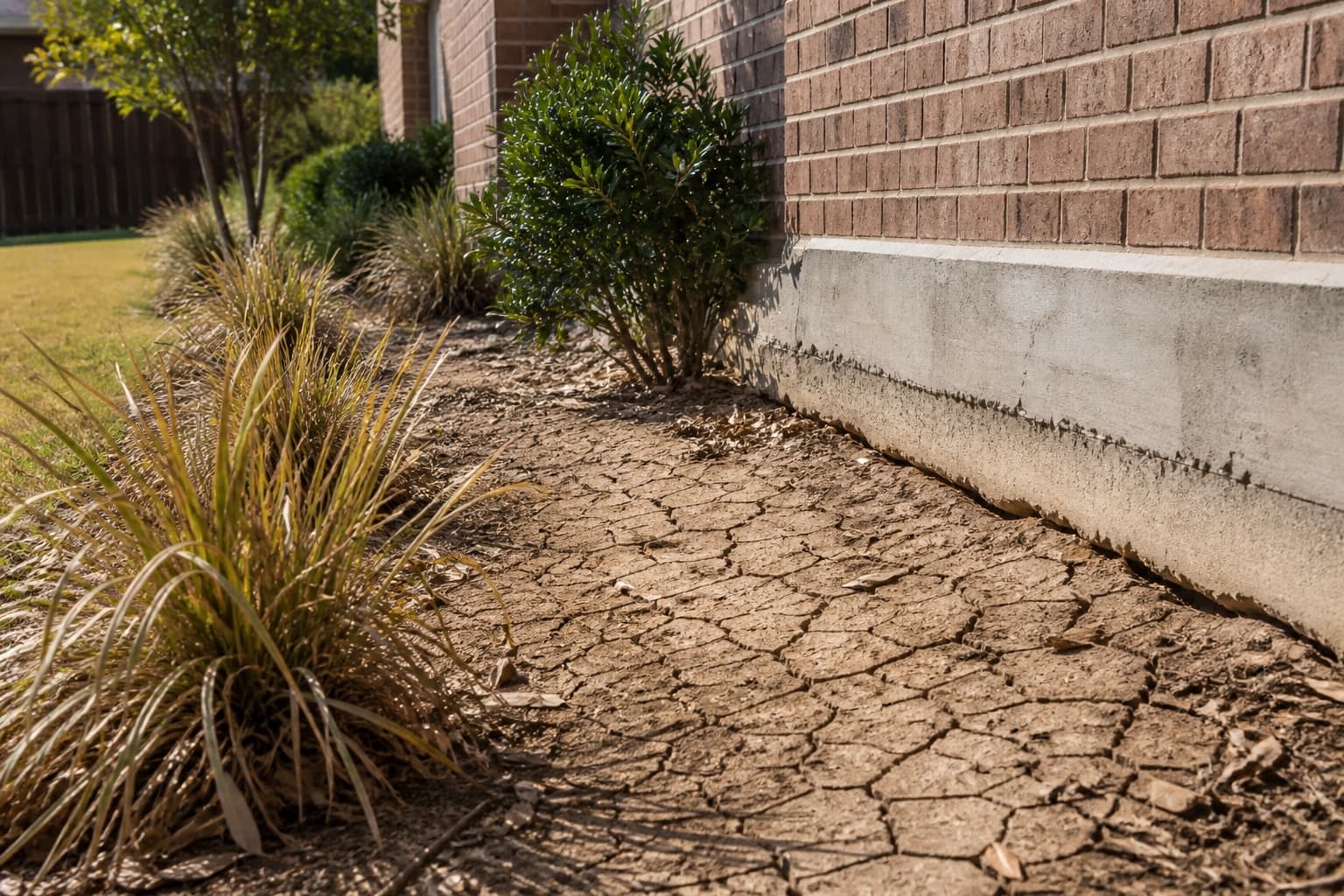
Extended dry weather can reduce moisture in supporting soil, but drought does not affect every North Texas property in the same way. Soil composition, foundation type, shade, irrigation, landscaping, drainage, plumbing, paving, and moisture distribution can create different conditions around the same building.
Dry soil gaps or new cracks deserve documentation, not an automatic conclusion. Compare the property over time and use inspection measurements when building changes appear.
Soil response depends on composition and moisture
Some clay-rich soils can change volume as moisture changes. Other soils and prepared fill behave differently. Even within one lot, utility trenches, landscaping, additions, drainage, and construction history can create variation.
The guide to expansive clay soil and foundations explains the general soil mechanism. A property evaluation is still needed to determine whether observed movement aligns with soil moisture, construction, plumbing, or another factor.
Drought can expose uneven moisture patterns
One side of a house may receive irrigation or deep shade while another is exposed to sun, wind, paving, or roof conditions. Trees and dense landscaping can affect moisture demand and access. A leaking line can create a wet area during an otherwise dry period.
The relevant question is not whether the region is dry, but how moisture is distributed at the property and whether the foundation observations form a corresponding pattern.
Soil separation is an observation, not a measurement of movement
Gaps between soil and a slab edge can appear during dry conditions. Photograph the location, width reference, nearby grade, vegetation, irrigation, and date. Do not fill deep gaps with loose material in a way that directs later rain toward the foundation.
Soil separation does not reveal the foundation elevation or support condition. Relative floor measurements and corroborating distress are needed to evaluate building response.
Trees require property-specific advice
Tree size, species, health, distance, root distribution, shade, irrigation, and soil all matter. Removing a tree can also change moisture and site conditions. Avoid assuming that visible roots prove foundation damage or that removal is a foundation repair.
An arborist may be appropriate for tree-health and root-management questions. Foundation, drainage, and landscaping professionals may need to coordinate when recommendations overlap.
Watering advice has limits
Generic watering schedules can be inappropriate when drainage is poor, a plumbing leak exists, water restrictions apply, or one part of the property already stays wet. Excess water can create erosion, ponding, crawlspace moisture, or uneven conditions.
Foundation maintenance guidance should begin with the property’s grading, roof runoff, irrigation coverage, vegetation, soil exposure, and observed moisture. It should not be presented as a guarantee against movement.
Rain after drought can reveal drainage problems
Dry soil and hardened surfaces may accept water differently when rain returns. Clogged gutters, short downspouts, low grades, and compacted landscaping can concentrate runoff.
Review how roof runoff reaches the foundation perimeter and the broader drainage movement guide. Observe where water collects and exits rather than assuming rain uniformly restores soil moisture.
Monitor building changes consistently
Record cracks, doors, floors, soil gaps, irrigation changes, plumbing events, and drainage observations with dates. Repeat photographs from the same position. Do not compare informal floor readings taken with different tools or reference points as if they were a professional elevation survey.
The foundation monitoring guide provides a repeatable log. Progressing conditions, unsafe changes, active leaks, or significant utility concerns can require prompt evaluation rather than extended monitoring.
Use inspection to decide the next step
A foundation inspection can compare floor measurements, cracks, openings, foundation type, additions, prior repairs, drainage, grading, irrigation, trees, plumbing indicators, and site conditions. The findings may support maintenance, drainage correction, plumbing evaluation, structural repair, specialist input, or continued observation.
Drought is useful environmental context, but it should never substitute for evidence from the individual property.