
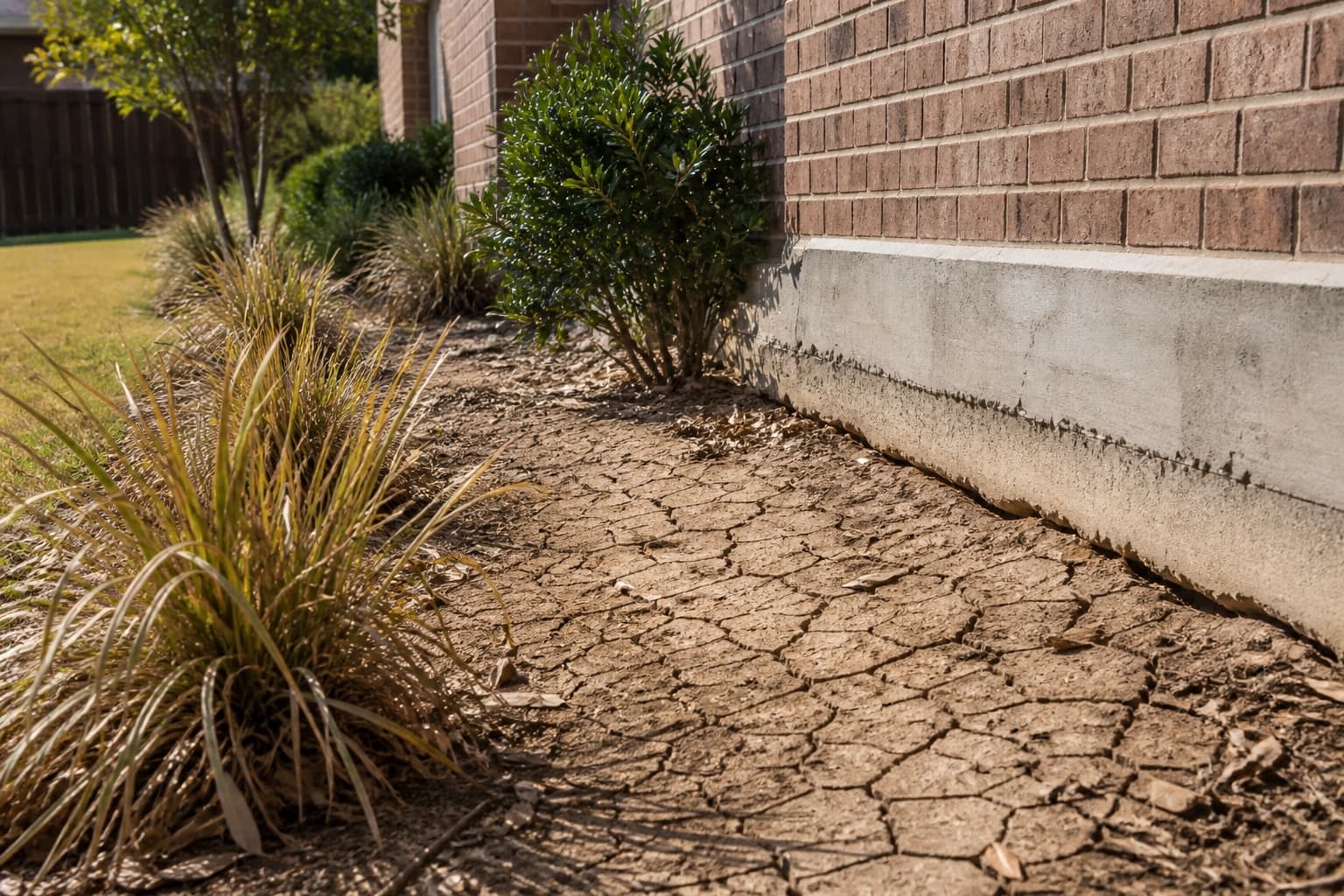
Expansive clay is widely discussed in North Texas because clay-rich soils can change volume as moisture conditions change. That regional fact is useful background, but it does not explain a crack, floor slope, or sticking door at a particular home.
A foundation interacts with the supporting soils below it, the building above it, and the water conditions around it. Understanding that system helps homeowners ask better questions without treating “clay soil” as a complete diagnosis.
What makes clay soil expansive
Clay contains very small mineral particles with the ability to attract and hold water. Some clay-rich soils increase in volume when moisture rises and decrease in volume as they dry. The amount and uniformity of that change depend on the soil composition, depth, density, drainage, vegetation, weather, and how the site was prepared.
The practical concern for a foundation is differential movement. If supporting conditions change more beneath one area than another, parts of the foundation can respond differently. This concept applies to both slab and raised-floor construction, but the visible symptoms and inspection methods differ.
Why moisture distribution matters
Uniform conditions are rarely created by weather alone. A property has roofs, gutters, downspouts, paving, landscaping, fences, utility trenches, irrigation, and neighboring grades. Each can influence where water arrives and how quickly an area dries.
Extended dry weather
During a dry period, exposed soils can lose moisture. Shade, irrigation, vegetation, and soil cover can make that drying uneven around the perimeter. A visible soil gap beside the slab describes a dry surface condition; it does not reveal what is happening at every depth below the foundation.
Heavy or concentrated rainfall
Intense rain can create localized saturation where downspouts stop near the wall, roof valleys discharge without collection, low areas hold water, or hardscape directs runoff toward the building. The important inspection question is where water comes from, where it collects, and where it can leave.
Plumbing and irrigation leaks
A supply, drain, pool, or irrigation leak can introduce water to a limited area. When the movement pattern or moisture observations point toward a leak, testing by the appropriate trade can provide information that a visual foundation inspection cannot.
Property features that influence soil moisture
Several common site features belong in the evaluation:
- Gutters and downspouts: Concentrated roof water needs a suitable route away from the structure.
- Grading: Surface slopes and low points influence runoff, but adding soil without checking clearances, drainage, and materials can create new problems.
- Driveways and patios: Paving can shed water, settle independently, or limit how quickly nearby soils exchange moisture.
- Trees and landscaping: Roots, canopy, irrigation, species, distance, and bed design all affect the local water context. Tree presence alone does not establish cause.
- Retaining features: Walls and terraces can change runoff, access, erosion, and the way a sloped lot is observed.
- Additions: New foundation sections, patios, and room additions can alter drainage and create construction transitions that need separate interpretation.
These conditions are reviewed during a foundation inspection because the same regional soil can interact differently with two neighboring properties.
What homeowners can monitor responsibly
Homeowners can create a useful record without attempting invasive tests. Walk the accessible perimeter after ordinary dry weather and again after rainfall. Note where water ponds, where erosion appears, and whether downspout discharge reaches an appropriate outlet. Inside, document changing cracks, openings, and floor concerns with dates.
Practical records include:
- Dated photographs from consistent interior and exterior viewpoints
- Notes about plumbing repairs, irrigation leaks, or unusually wet areas
- Locations of large trees, recent removals, and significant landscape changes
- Prior foundation, drainage, or addition documents
- Rainfall observations made from a safe location
Avoid using a regional watering rule as a substitute for property guidance. Water restrictions, vegetation needs, drainage conditions, plumbing, and the actual soil profile all affect what is appropriate. Foundation maintenance should be tailored to observed site conditions and should never be presented as a guarantee against movement.
How an inspection evaluates the soil-and-foundation relationship
A foundation inspector does not diagnose soil chemistry by appearance. The inspection documents the building’s movement pattern and then examines site conditions that can help explain or challenge that pattern.
The evaluation commonly considers:
- Relative floor elevations and where changes occur
- Interior and exterior distress that supports or conflicts with the measurements
- Slab, pier and beam, or mixed foundation construction
- Drainage, roof runoff, grading, hardscape, and erosion
- Plumbing indicators and available testing information
- Trees, irrigation, additions, and prior repairs
- Limits on access or concealed conditions
If the findings support a structural response, the recommendation should explain why foundation repair is appropriate. If active water paths are central to the evidence, drainage correction or specialist testing can belong earlier in the sequence.
Avoid common soil assumptions
“The soil is clay” is not the same as “the foundation needs repair.” Likewise, rainfall, drought, a mature tree, or a visible surface gap does not identify the movement direction or repair method. Each is one piece of context.
Use the drainage and foundation movement guide to trace moisture sources, the foundation warning-sign guide to document visible changes, and the inspection guide to understand how those observations are evaluated together.