
A drop at the garage entrance
A driveway panel that sits below the garage slab should be measured with the door, threshold, slope, and water route in view.
Concrete & flatwork service
Property-specific evaluation of settled driveway panels, garage transitions, drainage, cracking, and underlying support conditions.
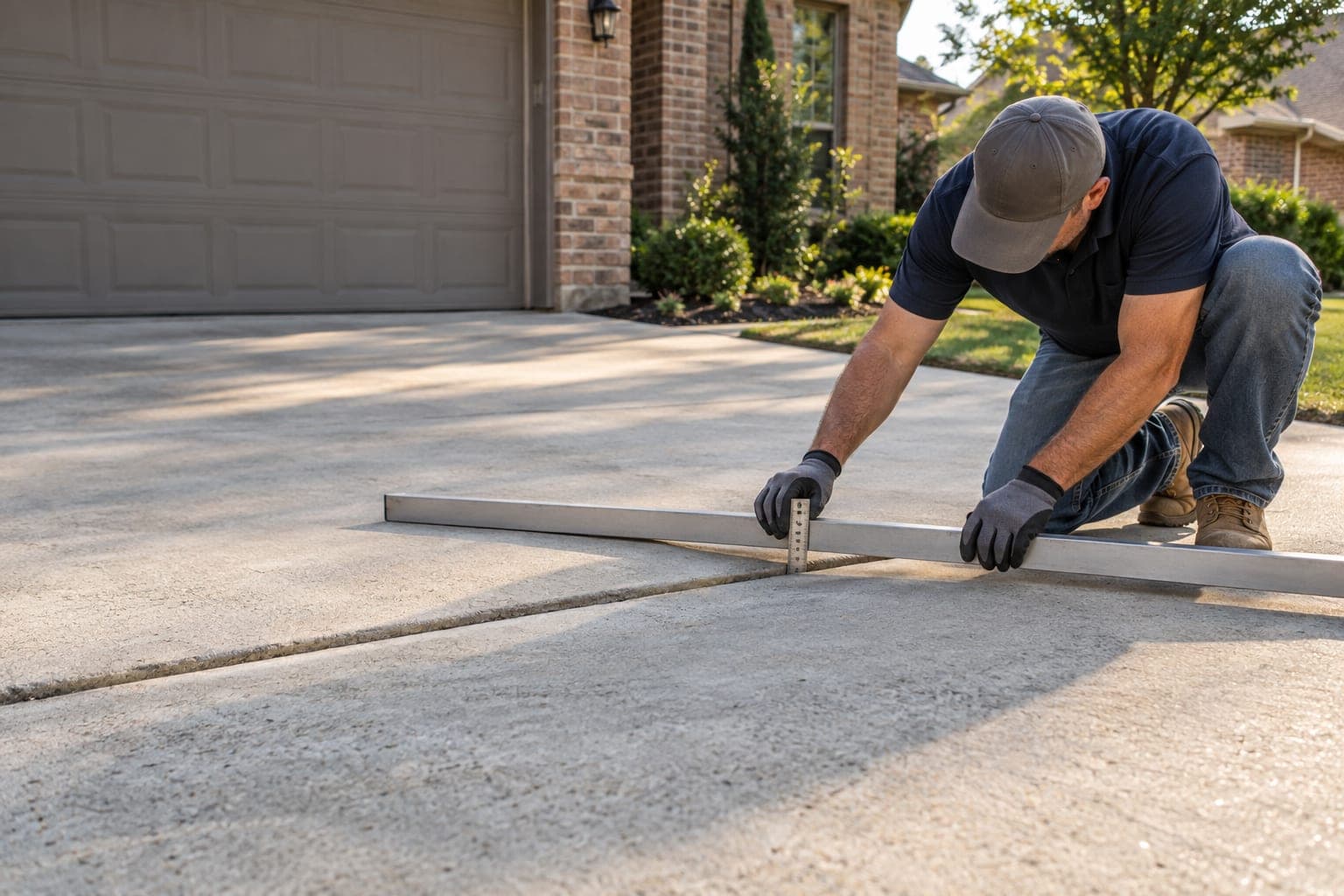
A driveway can settle at the garage, along an expansion joint, beside a walkway, or near an edge where runoff has affected the supporting soil. The resulting height difference may interrupt drainage, create an awkward transition, or make the driveway feel uneven underfoot and under tires.
Driveway leveling starts by determining whether the affected concrete is intact enough to adjust and whether a practical target elevation exists. Cracking, panel thickness, garage and curb elevations, access, drainage, buried utilities, and support below the slab all influence whether lifting, partial replacement, drainage work, or monitoring deserves consideration.
The evaluation should account for slab condition, target elevations, access, drainage, grading, and surrounding site conditions before lifting, replacement, or another response is selected.
Warning signs
These observations can have more than one explanation. Look for patterns, progression, and multiple signs in the same part of the property.
A driveway panel that sits below the garage slab should be measured with the door, threshold, slope, and water route in view.
One panel may settle differently from the next, leaving a vertical transition that changes how the driveway drains and feels.
Standing water can point to a changed panel slope, a blocked outlet, or a broader grading issue around the driveway.
Movement where the driveway meets a sidewalk, curb, or approach can involve several fixed elevations that limit the possible adjustment.
Possible contributors
North Texas soil and weather can be relevant, but compaction, erosion, drainage, slab construction, roots, utilities, and site history also belong in the evaluation.
Fill settlement, erosion, or repeated soil movement can leave uneven support beneath part of a driveway slab.
Roof discharge, side-yard flow, and driveway runoff may concentrate water where it can move fine soil or keep an edge repeatedly wet.
North Texas moisture changes can affect supporting soils differently across a broad paved area.
Panel dimensions, reinforcement, joint layout, prior patches, and existing deterioration affect how a driveway can be evaluated.
Inspection process
The review identifies garage slabs, curbs, walks, steps, drains, utilities, and neighboring panels that should not be treated as one moving surface.
Height changes, slopes, cracks, ponding areas, and runoff routes are documented before a target is discussed.
Panel integrity, access, support conditions, and the amount of practical adjustment help determine whether lifting or replacement is the better conversation.
If service is recommended
01 / Define eligible panels and targets
A proposed scope identifies the panels being considered, the intended transition, access points, and conditions that limit movement.
02 / Lift in controlled increments
If leveling is selected, the slab response and adjacent elevations are monitored while the approved panels are adjusted.
03 / Recheck transitions and drainage
The finished area is reviewed for practical panel relationships, water flow observations, cleanup, and any separate work still worth considering.
Keep exploring
Questions
Sometimes. The decision depends on the condition of each affected panel, the amount and pattern of settlement, the available target elevation, access, and support conditions beneath the slab.
A settled approach may be adjustable, but the garage slab, door clearance, drainage slope, and neighboring panels limit the target. Those relationships should be measured on site.
No. Driveway flatwork and a building foundation are separate systems. Similar soil or drainage conditions may affect both, but the driveway alone does not diagnose the house foundation.
Replacement may deserve comparison when panels are extensively cracked, deteriorated, poorly configured, or unable to reach a useful elevation without creating another problem.
Property-specific next steps
Tell us where the driveway changed, how it meets the garage or walk, and what happens to water after rain so the affected panels can be reviewed in context.