
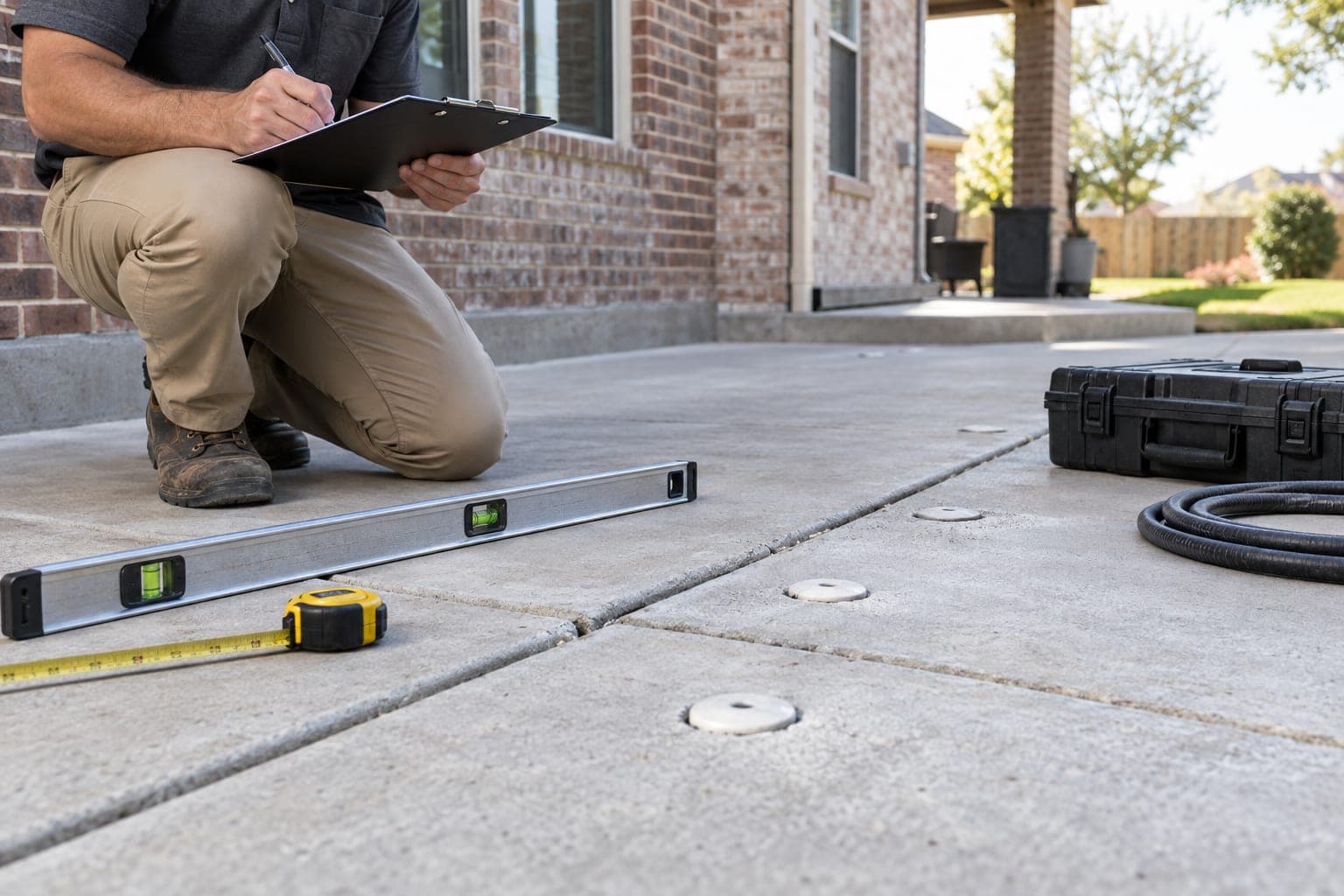
Concrete leveling is the objective; the repair method is the means used to reach it. Contractors may discuss polyurethane foam injection, polyjacking, mudjacking, slabjacking, cementitious grouts, mechanical lifting, or another system. Those names describe broad categories, not a complete property recommendation.
TX Foundation Pros uses method-neutral language here because the existing project documentation does not verify one exclusive lifting material or process. Your written scope should identify what is actually offered for the inspected slab.
Start by deciding whether the slab is eligible
Before comparing materials, determine whether the concrete can be adjusted as a stable section. Review crack pattern, surface deterioration, panel dimensions, reinforcement clues, fixed edges, utilities, access, and the target relationship with neighboring surfaces.
A method cannot overcome every slab limitation. Concrete broken into unstable pieces or unable to reach a useful elevation may need selective or complete replacement. Use the leveling versus replacement guide to organize that decision.
Polyurethane foam injection
Polyurethane lifting generally introduces an expanding material beneath concrete through drilled access points. Contractors may use the terms foam injection or polyjacking. The material is commonly discussed as lighter than traditional cementitious mixtures and often uses comparatively small access holes, but product and installation details vary.
Ask which product is proposed, how expansion and slab movement are controlled, how the contractor addresses open edges and utilities, and what use restrictions apply. Do not infer capacity, lifespan, environmental performance, or guaranteed void coverage from the word “foam.”
Mudjacking and cementitious mixtures
Mudjacking generally pumps a cementitious or soil-cement mixture below a slab through access holes. Formulation, weight, flow, hole layout, equipment, cure considerations, and contractor controls vary.
Ask how the mixture is selected, how much added material the support conditions can accept, how the target is monitored, and how access points are finished. The detailed polyjacking versus mudjacking comparison helps place these two approaches side by side.
Other grout or fill approaches
Some scopes may use other flowable or engineered materials to fill accessible spaces, support a slab, or assist adjustment. Product descriptions can sound similar while installation requirements and intended uses differ.
Request the product or material category, purpose, placement process, limitations, and documentation. Filling a space and lifting a slab are related but not identical objectives, and a proposal should state which is intended.
Mechanical adjustment and reconstruction
Some situations may involve mechanical lifting, temporary support, edge access, rebuilding support, or a combination of methods. Others are better addressed by removing and replacing concrete. These approaches can require different access, demolition, reinforcement, base preparation, finishing, and cure planning.
No general guide can determine which is available or appropriate at a specific property. The contractor should explain why the selected method fits the slab rather than merely naming equipment.
Drainage and support remain part of every method
Concrete can settle when fill consolidates, soil moisture changes, or water contributes to erosion and voids. A lifting material does not automatically correct roof discharge, poor grading, irrigation, leaking lines, open joints, or an inadequate outlet.
Review why concrete sinks in North Texas and how poor drainage can affect concrete. If water management is relevant, a separate drainage correction scope may need to coordinate with the concrete work.
Application changes the method discussion
A driveway involves vehicle use, broad panels, garage thresholds, and curb transitions. A sidewalk has shorter sections, roots, steps, and a connected walking route. A patio includes doors, walls, posts, and water near the home. Pool-deck work must respect coping, drains, utilities, and pool systems outside the flatwork scope.
The same product may not be equally practical in every application, even within one property.
Compare proposals beyond price
Ask each proposal to identify the panels, repair objective, access points, method and material, intended lift, support or void assumptions, monitoring, use restrictions, drainage dependencies, patch appearance, cleanup, exclusions, change-order process, warranty, and documentation.
If two contractors propose different methods, first confirm that they are solving the same problem. One may include several panels, drainage coordination, or restoration that the other excludes. The concrete leveling cost guide explains why area alone may not produce a comparable estimate.
Understand limitations and future movement
No lifting method can guarantee that every crack closes, every panel becomes perfectly level, drainage works without a suitable outlet, or supporting soil never changes. The service may adjust eligible concrete without restoring it to new construction.
Read how long concrete leveling lasts as a discussion of influencing factors rather than a universal year count. Future performance depends on the complete property context.
Let the inspection select the next question
A concrete leveling evaluation should identify the slabs, fixed elevations, drainage, visible condition, access, and practical target before a method is selected. It may conclude that lifting is reasonable, that replacement deserves comparison, that drainage needs attention, or that another specialist should review part of the site.
Schedule an evaluation, then require the written scope to name the actual method. That sequence keeps the slab and property—not a product label—at the center of the decision.