
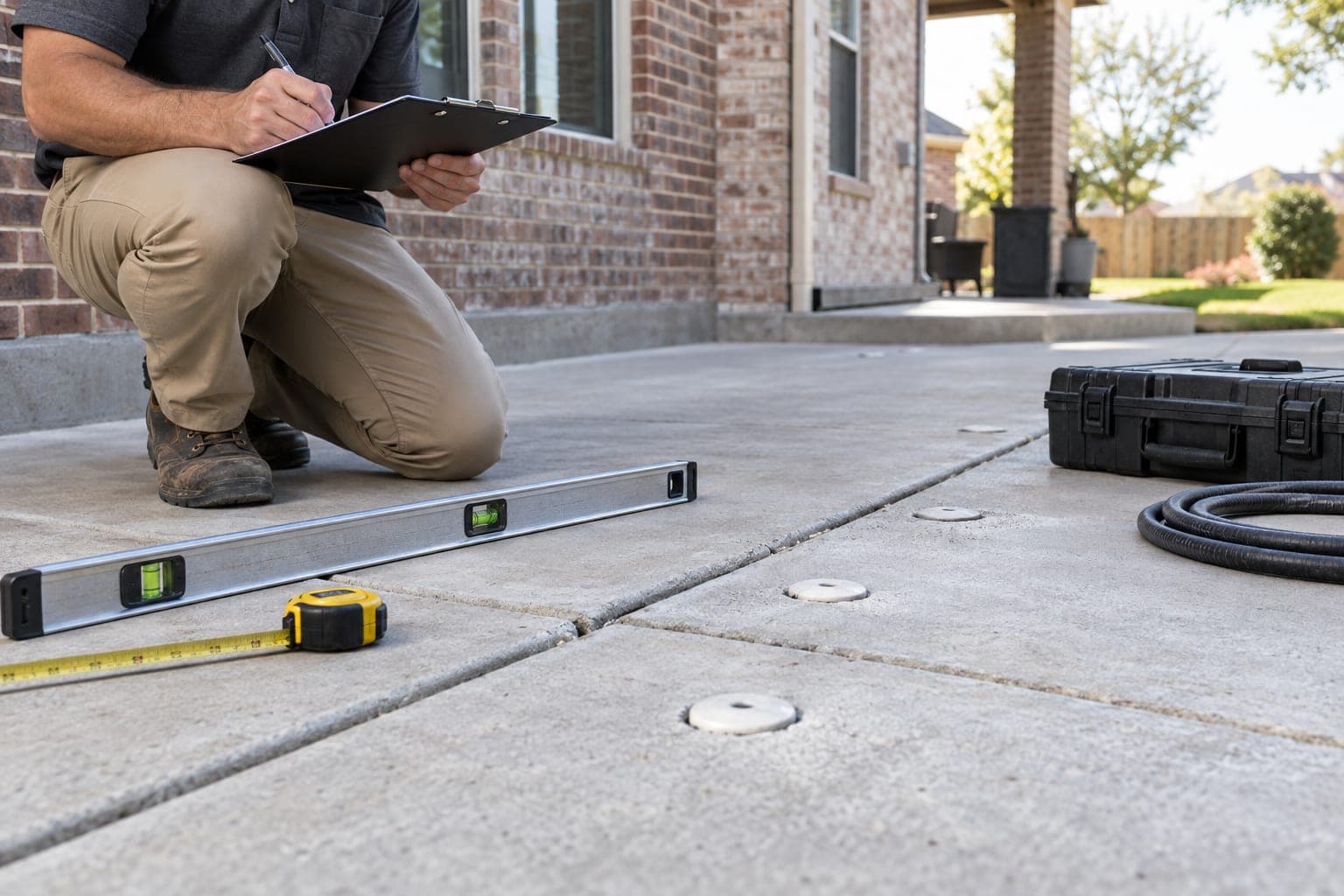
Polyjacking and mudjacking are two terms homeowners often encounter while researching settled concrete. Both describe methods that may lift an existing slab by introducing material beneath it, but they use different materials and job controls. The method name does not establish whether a slab should be lifted, how far it can move, or whether the support and drainage conditions have been addressed.
TX Foundation Pros does not use this guide to claim that either specific method is offered. Confirm the proposed system, product, access points, objectives, exclusions, and limitations in writing for your property.
What polyjacking generally means
Polyjacking commonly refers to injecting an expanding polyurethane material beneath concrete. Contractors may also call it foam lifting, polyurethane concrete lifting, or foam injection. The material is introduced through access holes and expands according to the product and installation process.
Homeowners should ask which product is proposed, how expansion is controlled, how the contractor monitors slab movement, what happens at open edges and utilities, and how access holes are finished. Avoid assuming that the word “polyurethane” establishes capacity, environmental performance, durability, or return-to-use time.
What mudjacking generally means
Mudjacking commonly uses a pumpable cementitious or soil-cement mixture placed beneath a slab through access holes. The material formulation, equipment, hole pattern, and placement sequence vary by contractor and application.
Ask what mixture is used, how voids and lift are assessed, how much material weight is added, how the slab response is monitored, and what cure or use restrictions apply. The general method label does not answer those project details.
Access-hole size and layout vary
Polyurethane systems are often associated with smaller access holes than traditional mudjacking systems, but exact hole dimensions and spacing depend on the equipment, product, slab, and contractor. A proposal should show where access points may be placed and how they will be patched.
Hole size is only one consideration. A small access point does not prove the slab is suitable for lifting, and a larger access point does not by itself make a method inappropriate. Panel integrity, lift target, utilities, edges, coatings, and visible finish expectations also matter.
Material weight is different, but support still controls the result
Polyurethane materials are generally lighter than cementitious mudjacking mixtures. That difference can matter when discussing how much material is introduced below a slab. It does not remove the need to understand the supporting soil, suspected void, drainage, and continued movement.
Ask how the contractor estimates material needs, responds if material travels beyond the intended area, and distinguishes void filling from the force needed to move the slab. Neither method can guarantee that changing soil or water conditions will stop.
Flow and expansion require different controls
A pumpable cementitious mixture flows under pressure, while polyurethane expands through a chemical reaction. Those behaviors require different installation controls and experience. The comparison should focus on how the chosen system reaches the intended area, supports the panel, and limits unintended movement.
Homeowners should also ask how nearby walls, steps, curbs, drains, coping, utilities, and connected panels are protected. The important question is not which material sounds more advanced; it is whether the complete scope fits the slab and site.
Applications overlap, but not every slab is eligible
Either approach may be discussed for some driveways, sidewalks, patios, pool-deck sections, or other flatwork. Eligibility depends on slab condition, access, geometry, target elevation, neighboring features, and contractor capabilities.
Concrete that is extensively broken or deteriorated may be a poor lifting candidate regardless of method. Review concrete leveling versus replacement before comparing products for a slab that may need reconstruction.
Drainage and settlement causes remain separate questions
Filling a void or raising a panel does not automatically correct the water route that may have contributed to lost support. Roof runoff, open joints, erosion, poor grading, irrigation, and an inadequate outlet can remain after either lifting method.
The guide to why concrete sinks in North Texas explains the site conditions that should be evaluated alongside the slab. A drainage correction scope may be separate from concrete work.
Compare proposals using the same questions
Ask each contractor to identify the affected panels, lift objective, method and material, access holes, expected patch appearance, monitoring process, use restrictions, drainage dependencies, exclusions, cleanup, documentation, and warranty terms. If the proposals use different methods, do not compare price without comparing scope.
The concrete leveling methods guide adds questions for mechanical approaches, replacement, and method-neutral evaluation.
Start with the slab, not the product name
The primary decision is whether concrete leveling is appropriate for the existing slab. Method selection comes after the panel condition, movement, target elevations, access, utilities, water route, and surrounding structures are understood.
A responsible evaluation can explain why one approach is proposed without claiming it is universally best. Request a concrete evaluation, then ask for the selected method and its limitations in the written scope.