
Uneven joints around the deck
A raised edge between sections should be measured with nearby coping, drains, and walking routes in view.
Concrete & flatwork service
Careful evaluation of settled concrete around pools, including deck transitions, drainage, coping relationships, access, and slab limitations.
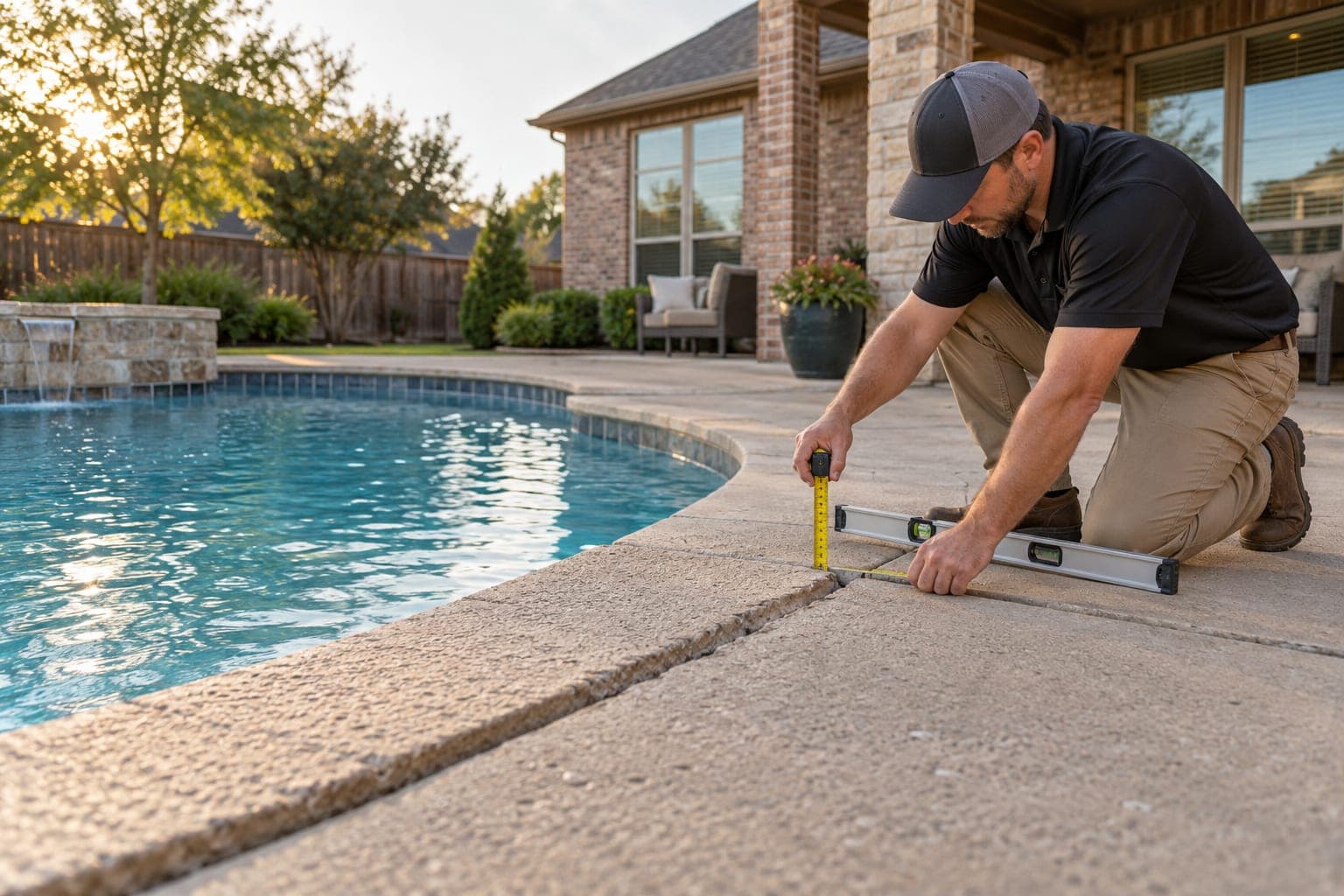
Concrete around a pool may settle at a joint, walkway connection, equipment route, patio edge, or area where water repeatedly collects. Pool decks require a careful review because the flatwork sits beside coping, drains, plumbing, electrical components, and a pool structure that may require separate specialist input.
Pool deck leveling focuses on eligible concrete sections, not pool plumbing or structural pool repair. The evaluation should identify what moved, how the deck relates to fixed pool components, where water travels, whether the slab remains intact enough to adjust, and when a pool professional should review another condition first.
The evaluation should account for slab condition, target elevations, access, drainage, grading, and surrounding site conditions before lifting, replacement, or another response is selected.
Warning signs
These observations can have more than one explanation. Look for patterns, progression, and multiple signs in the same part of the property.
A raised edge between sections should be measured with nearby coping, drains, and walking routes in view.
A changing gap may reflect deck movement, pool movement, or both and should not be diagnosed from appearance alone.
Ponding can indicate a changed slope, a drainage limitation, or a low area beyond the affected slab.
Crack pattern and deterioration influence whether a section can respond as a stable panel during adjustment.
Possible contributors
North Texas soil and weather can be relevant, but compaction, erosion, drainage, slab construction, roots, utilities, and site history also belong in the evaluation.
Fill settlement, erosion, or voids can affect isolated areas of poolside concrete without establishing what is happening to the pool itself.
Water may repeatedly follow joints or low edges, especially where deck drains or yard outlets do not carry it away effectively.
North Texas moisture cycles can affect support around broad hardscape areas, with covered and exposed zones behaving differently.
Coping, drains, plumbing, electrical systems, deck coatings, equipment, and connected patios can restrict possible work.
Inspection process
Deck panels, coping, pool shell, drains, equipment pads, patios, and walkways are distinguished before any movement is proposed.
Elevation changes, cracks, gaps, drainage paths, and accessible edges are documented around the affected area.
The review identifies which questions belong to concrete leveling and which require a pool contractor, engineer, plumber, electrician, or other specialist.
If service is recommended
01 / Set a pool-aware scope
Eligible deck sections and target relationships are documented with coping, drains, access, utilities, and adjacent slabs in mind.
02 / Adjust eligible concrete carefully
If lifting is appropriate, movement is controlled and monitored around fixed pool components and neighboring flatwork.
03 / Review transitions and referrals
The deck surface and water route are reviewed, and conditions outside the concrete scope are identified for the appropriate specialist.
Keep exploring
Questions
No. Coping relationships, slab damage, utilities, drains, access, coatings, and the amount of required movement can make replacement or specialist review more appropriate.
No. Concrete flatwork leveling does not replace pool structural, plumbing, electrical, or equipment evaluation. Those conditions should be handled by appropriately qualified specialists.
The deck and pool components should be evaluated separately before movement is attempted. The visible gap alone does not identify which component moved or what work is appropriate.
Adjusting an eligible section may change its slope, but drains, deck geometry, yard grade, coping clearance, and the downstream outlet still control whether water can leave the area.
Property-specific next steps
Tell us which deck section changed and note nearby coping, drains, cracks, equipment, utilities, or ponding so the flatwork scope can be defined responsibly.