
A vertical edge between panels
An uneven joint should be measured along with the direction of movement and the elevations at both ends of the panel.
Concrete & flatwork service
Evaluation of settled sidewalk and walkway panels with attention to transitions, drainage, roots, adjacent structures, and slab condition.
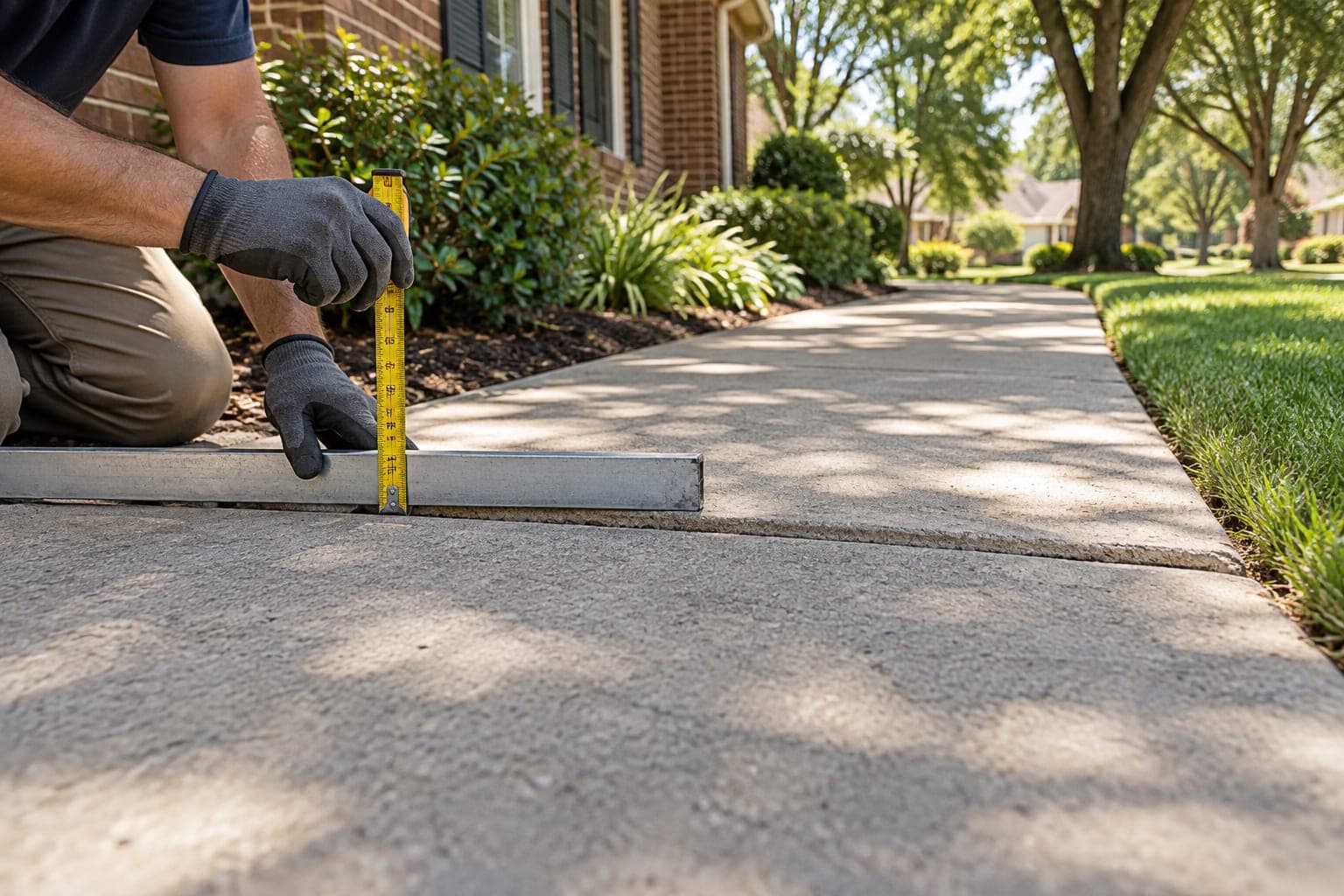
A sidewalk does not have to move uniformly. One section may settle beside an entry walk, driveway, porch step, gate, or landscaping edge while the next panel stays near its original elevation. That difference can interrupt the route and alter where water collects.
Sidewalk leveling is a panel-specific decision. The evaluation should distinguish settlement from heave, review roots and drainage without assuming either is the cause, and account for cracks, joint layout, curb connections, access, and the elevations of fixed steps or landings.
The evaluation should account for slab condition, target elevations, access, drainage, grading, and surrounding site conditions before lifting, replacement, or another response is selected.
Warning signs
These observations can have more than one explanation. Look for patterns, progression, and multiple signs in the same part of the property.
An uneven joint should be measured along with the direction of movement and the elevations at both ends of the panel.
A changed walkway slope may direct water toward a landing or wall and should be reviewed with the surrounding grade and outlet.
Low panels can hold water, although landscape edging, soil buildup, and downstream drainage may also contribute.
Movement under foot can suggest incomplete support or a broken panel and requires closer review before an adjustment is proposed.
Possible contributors
North Texas soil and weather can be relevant, but compaction, erosion, drainage, slab construction, roots, utilities, and site history also belong in the evaluation.
A short walkway may cross fill, utility trenches, or soil zones that consolidate differently over time.
Runoff and irrigation can soften or erode support where water repeatedly follows the same edge or joint.
Roots, changing vegetation, and soil moisture near planting areas may affect panels, but the direction and condition must be assessed rather than assumed.
Steps, porches, curbs, and driveways can stay in place while adjacent walkway panels move, leaving limited adjustment choices.
Inspection process
The review follows connected panels from the driveway or public walk to entries, gates, steps, and side yards.
Panel heights, cracks, roots, edges, drainage, utilities, and fixed landings are noted before a service target is established.
The integrity and geometry of each section help show whether leveling, selective replacement, or another correction is more practical.
If service is recommended
01 / Prioritize the usable route
The scope identifies the important transitions and the realistic elevation relationship between the affected walkway panels.
02 / Adjust eligible sections carefully
When lifting is selected, the work follows the approved targets while accounting for cracks, neighboring slabs, and fixed entry points.
03 / Review the route after service
Panel joints, water movement, cleanup, and remaining conditions are reviewed without promising that every surface variation can be removed.
Keep exploring
Questions
Not necessarily. Fixed steps, curbs, driveways, roots, panel damage, and available slope can limit adjustment. The goal should be tied to what the existing route can reasonably support.
Yes. Roots may influence elevation, access, and future movement, but they should not be cut or treated without understanding the tree, panel, and property conditions.
It may be, depending on the crack pattern, whether the panel can act as a stable section, the target elevation, and the condition of the concrete around the crack.
No. Leveling can address selected elevation differences, but no service can guarantee a route will remain free of every surface change or future movement.
Property-specific next steps
Show us which panels changed and where the route meets steps, entries, driveways, landscaping, or drainage paths so the full transition can be assessed.