Drainage Company in Plano, TX | French Drain Installation
Work with a drainage company in Plano for grading, surface collection, roof-water routing, and French drain installation decisions based on how water actually moves across your property. Schedule a free drainage evaluation before choosing a system.
Plano drainage concerns can look similar at the surface while beginning from very different sources. Water between homes may come from roof discharge, irrigation, an uphill lot, broad paving, or a low landscape area with no dependable outlet. A useful drainage company evaluation separates those inputs and follows the route beyond the wet spot before grading, inlets, solid pipe, or French drain installation is recommended.
Properties in Willow Bend, the Legacy area, East Plano, and other parts of the city also have different lot sizes, hardscape patterns, mature landscaping, utility constraints, and community features. Those geographic differences guide questions, but they do not establish a diagnosis. The free drainage evaluation remains tied to the individual property's elevations, responsibilities, maintenance access, and lawful discharge options.
City-specific context
Plano drainage planning changes with lot form and connected hardscape
A broad estate lot, a compact planned-community side yard, and an established East Plano home can require different collection and conveyance strategies even when each homeowner reports ponding.
01
Willow Bend
Larger homes and lots may combine broad roofs, long drives, pool areas, landscape beds, walls, and several potential outlets. The evaluation should divide the property into drainage areas instead of routing every source into one assumed solution.
02
Legacy-area communities
Planned streets, compact setbacks, alleys, shared-facing landscapes, and dense utility corridors can limit trench alignments. Ownership and discharge permissions should be confirmed before a private system crosses or affects another area.
03
East Plano
Established homes can have mature trees, older grading, later patios, driveway additions, and drainage changes made over time. Current elevations and visible routes matter more than assuming the original condition remains unchanged.
04
Homes with pools and outdoor living areas
Decks, outdoor kitchens, walls, equipment pads, drains, and landscape renovation can interrupt surface flow or create several collection points. Pool and plumbing systems remain separate diagnostic scopes.
Method follows the water path
Plano yard drainage solutions and drainage system installation
The selected scope should match the water behavior and provide an observable, maintainable path to a suitable destination.
01
Property-specific drainage correction
A drainage correction plan may coordinate grading, collection, conveyance, and outlet work after the source and constraints are documented.
A French drain may be evaluated where water moves through saturated soil and sufficient fall, trench access, filter design, and discharge are available.
Catch basins or channel drains can collect surface water where a defined low point and gravity route exist, provided debris access and outlet maintenance are planned.
Drainage observations do not prove structural movement. Interior symptoms, floor measurements, foundation type, and visible distress require a separate property-specific review.
French drain installation in Plano: when subsurface collection may fit
A French drain is generally intended to intercept water moving through permeable aggregate and soil, not to serve as a universal answer for every wet yard. The trench still requires a defined source, workable elevation, filter strategy, maintainable route, and suitable outlet.
Suitability for the actual water source
Subsurface collection may fit persistent saturation or seepage along a defined route. It may be less direct for roof water, fast surface runoff, irrigation leaks, plumbing indicators, or a low point that needs a visible inlet.
Trench alignment and utilities
Plano side yards may contain gas, electric, communications, irrigation, pool lines, roots, and easements. Locating known services and planning access are essential before depth or alignment is finalized.
Filter and maintenance planning
Aggregate, fabric, soil contact, cleanouts, surface debris, and outlet access influence how the system can be inspected and maintained. Concealing every component can make future problems difficult to identify.
A stable discharge point
Gravity flow needs enough fall and a destination that does not create erosion, nuisance flow, or an unapproved cross-boundary discharge. Pumps add electrical, maintenance, and failure considerations when gravity is unavailable.
Cost and alternative comparison
Length, depth, access, utilities, roots, crossings, aggregate, restoration, and outlet construction affect cost. Regrading, surface drains, solid downspout pipe, or source correction may be more appropriate than a French drain in some areas.
Recurring water should be organized by source, timing, route, and destination rather than labeled from one photograph or a neighborhood pattern.
Water held between closely spaced homes
Narrow side yards may receive runoff from two roofs, air-conditioning condensate, irrigation, and uphill surfaces. The evaluation needs to determine whether the water is moving across the surface, through saturated soil, or from an active leak.
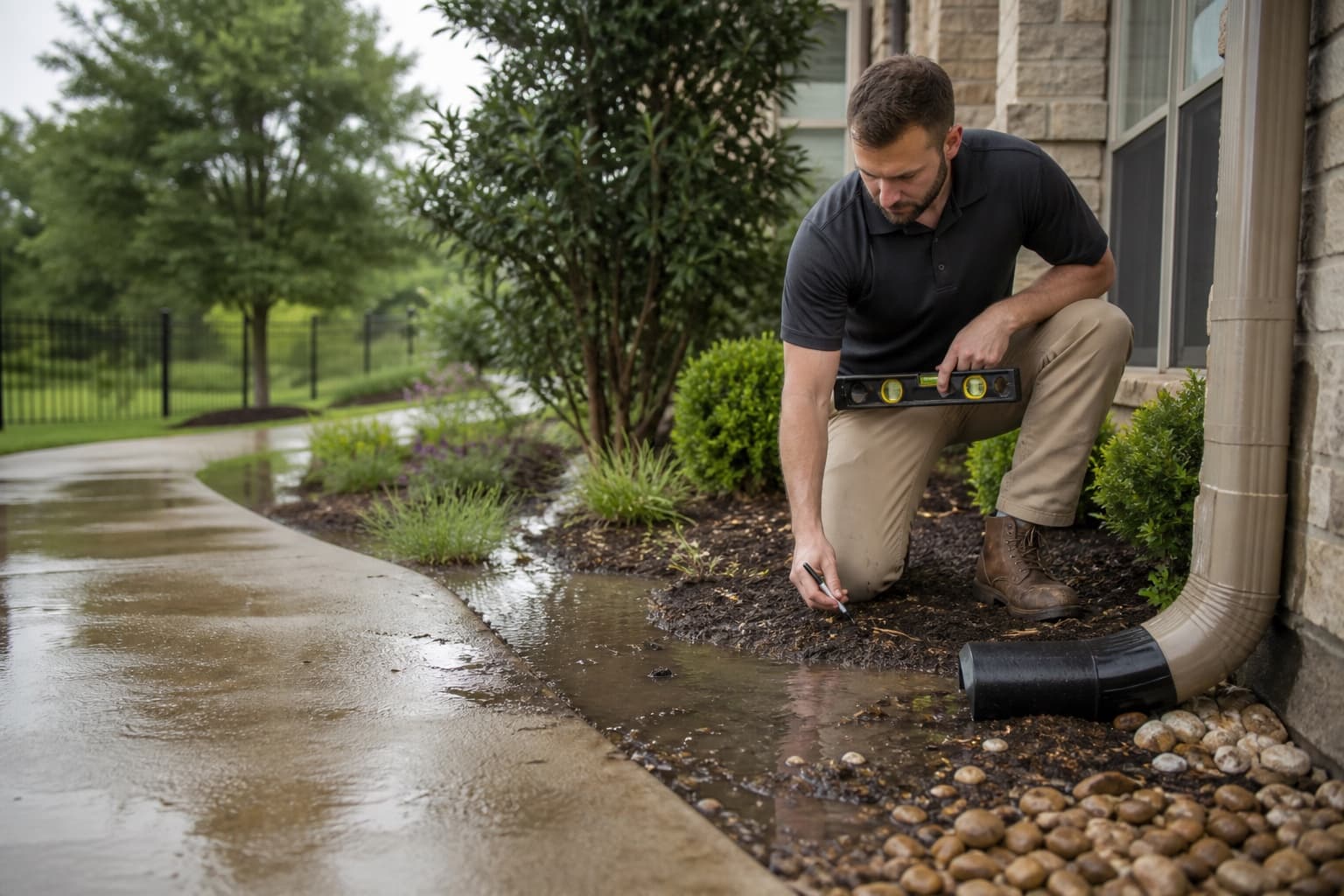
Downspout discharge trapped by hardscape
A short gutter outlet beside a walk, driveway, wall, or patio can concentrate roof water where grading options are limited. Solid conveyance may be more appropriate than a groundwater collection trench for that source.
Ponding in landscape beds or lawn low points
Soil buildup, edging, settled grade, compacted routes, or blocked outlets can create visible pools. Surface regrading or an inlet may fit some conditions, while others require a broader route correction.
Runoff crossing patios, drives, or pool decks
Connected hardscape can carry water efficiently but direct it toward doors, foundations, landscape beds, or lower neighboring surfaces. Each fixed elevation limits how the route can be changed.
Erosion near outlets and slopes
Concentrated discharge can move mulch, expose soil, or create a channel. A pipe without outlet protection may relocate the concern instead of completing the drainage plan.
Source-to-outlet inspection
How a Plano drainage company evaluation follows the water
The visit moves from reported symptoms to sources, elevations, routes, constraints, and discharge before a drainage system installation is scoped.
1
Document timing and sources
The review asks whether water appears during storms, irrigation, pool use, condensate discharge, plumbing activity, or otherwise dry weather.
2
Read the visible grades
Foundation edges, beds, swales, paving, walls, low points, inlets, and neighboring elevations help show where gravity currently carries water.
3
Separate surface and subsurface behavior
Fast runoff, standing surface water, saturated soil, and seepage require different collection questions and should not be grouped automatically.
4
Identify route constraints
Utilities, easements, roots, fences, pools, hardscape, gates, shared features, and maintenance access can change the feasible alignment.
5
Confirm outlet and scope
The recommendation should identify the collection method, pipe route, discharge, cleanouts, restoration, exclusions, and any approvals or specialist services still needed.
Related, not interchangeable
Foundation drainage and flatwork connections in Plano
Water management, building foundations, and exterior concrete can influence one another without becoming the same repair scope.
Moisture near the foundation
Ponding and concentrated discharge are useful observations, but they do not establish why a foundation moved. Drainage and structural evidence should be compared without assuming causation.
Settled patios and walkways
A low slab can hold or redirect water. Flatwork condition, target elevation, and support need their own evaluation before drainage work is expected to correct the surface.
Plumbing and irrigation indicators
Water during dry weather, meter changes, soft isolated areas, or recurring saturation may justify plumbing or irrigation testing outside the contractor drainage scope.
Monitoring after correction
A completed system should be observed during appropriate weather and maintained. Changes in foundation or concrete conditions still require separate documentation over time.
What affects drainage and French drain cost in Plano
Pricing depends on a designed route and actual site constraints. A generic per-foot number does not account for collection method, depth, crossings, utilities, outlet work, restoration, or whether the proposed system addresses the correct source.
Surface inlets, channel drains, French drain trenches, downspout connections, and grading each involve different materials, excavation, and maintenance provisions.
Length, fall, and outlet
Long routes, limited elevation, outlet protection, core drilling, pumps, or multiple discharge zones can change the scope substantially.
Access and crossings
Narrow gates, mature landscaping, roots, walls, patios, drives, pools, utilities, and occupied areas influence labor and restoration.
Approvals and separate services
Surveying, engineering, plumbing, electrical work, utility coordination, permits, association review, and municipal questions are separate when required.
Before the visit
Prepare for a Plano drainage evaluation
Safe observations during and after rain can clarify the source and route more effectively than selecting a drain product in advance.
01
Photograph downspouts, low areas, hardscape flow, inlets, outlets, and neighboring elevations from safe locations.
02
Note whether the condition occurs during storms, irrigation, pool operation, condensate discharge, plumbing use, or dry weather.
03
Gather available surveys, drainage plans, association documents, and records of landscaping or hardscape changes.
04
Identify known utilities, irrigation, pool lines, prior drainage pipes, cleanouts, and any route that has stopped flowing.
05
Describe where you believe water can discharge while remaining open to a different route after elevations are reviewed.
Continue your research
Plano drainage guides and nearby service areas
Use educational resources to prepare questions, then rely on property observations and measurements for the recommendation.
Does every wet Plano side yard need a French drain?+
No. The source may be roof runoff, surface grade, irrigation, a leak, neighboring flow, or subsurface saturation. French drain installation fits some subsurface conditions, while other sites need source correction, grading, an inlet, or solid conveyance.
Can a French drain connect directly to downspouts?+
Roof water is usually a concentrated source that may be better carried in solid pipe. Combining it with an aggregate collection trench can complicate capacity and maintenance, so the proposed design should explain each connection.
Where can a Plano drainage system discharge?+
The answer depends on elevation, property boundaries, easements, public or private systems, erosion control, and applicable requirements. The destination should be identified and verified before installation.
Will drainage correction stop foundation movement?+
No outcome can be guaranteed. Managing an identified water source may improve site conditions, while foundation performance depends on construction, soil, plumbing, weather, prior work, and other property-specific factors.
Can drainage be installed beneath a driveway or patio?+
Crossings may be possible, but concrete condition, utilities, depth, access, restoration, and future maintenance can affect feasibility and cost. Alternatives should be compared before cutting or tunneling is assumed.
What maintenance does a French drain require?+
Keep visible inlets and outlets clear, watch for erosion or reduced flow, manage surface debris, and use available cleanouts as directed. Maintenance depends on the installed design and surrounding landscape.
What is included in the free Plano drainage evaluation?+
The contractor visit reviews reported water behavior, visible grades, roof discharge, hardscape, route constraints, and potential outlets. Surveys, engineering, plumbing tests, permits, association approvals, and repair work are separate when needed.
Free drainage evaluation
Schedule a Free Drainage Evaluation in Plano
Tell us when water appears, where it starts, which surfaces or landscape features shape the route, and where you currently see it collect or discharge.