Lewisville yard drainage, runoff, and French drain planning
Drainage Company in Lewisville, TX | French Drain Installation
Schedule a free drainage evaluation with a drainage company in Lewisville for standing water, grading, downspout routing, and French drain installation across established and planned residential settings.
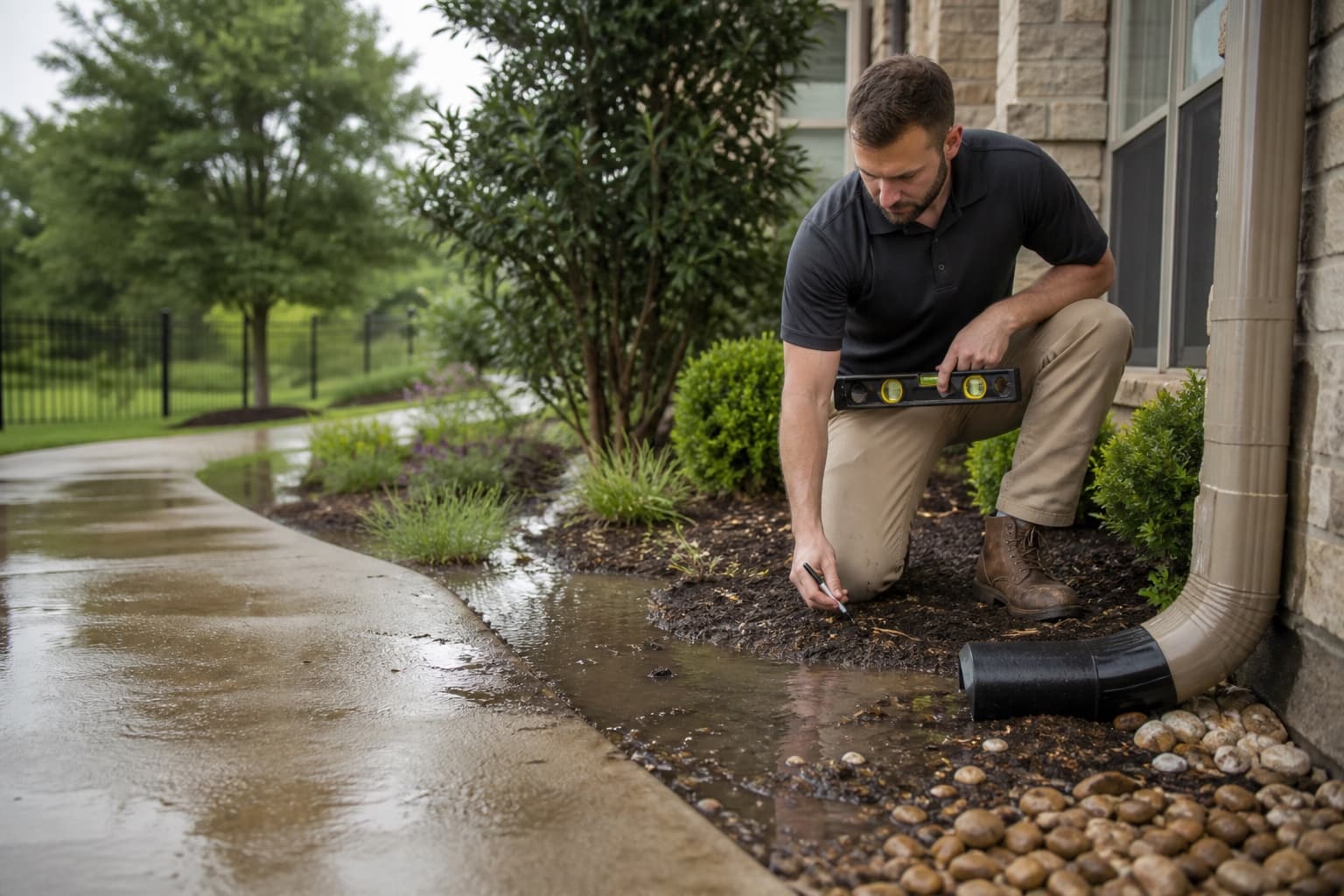
A drainage company in Lewisville may encounter older lots with altered paving, planned communities with shared drainage context, and sloped properties with several water zones. The first task is to determine whether water travels across the surface, remains within saturated soil, or arrives from roofs, irrigation, or another source. French drain installation is evaluated for defined subsurface conditions; it is not selected simply because a yard stays wet. The free drainage evaluation maps source, route, and outlet.
Old Town Lewisville, Castle Hills, Valley Ridge-area communities, and eastern neighborhoods toward Lewisville Lake contain different lot layouts and improvement histories. Castle Hills was annexed into Lewisville, and its community features may involve private and association responsibilities. Lake proximity provides geographic context but does not prove groundwater, soil saturation, or any condition at a particular residence.
Drainage work can be coordinated with the same-city concrete leveling page where settled patios or walks block runoff. Foundation observations remain separate and require their own measurements. A responsible proposal explains what water the system will collect, where it will travel, how it will discharge, and what maintenance or outside approvals remain with the property owner.
City-specific context
Lewisville drainage differs across older blocks, planned communities, and rolling lake-area grades
Property age, association boundaries, paving, terrain, and outlet access vary. Current elevations and observed water behavior matter more than broad geographic assumptions.
01
Old Town and central Lewisville
Older residential areas may contain bungalow-scale lots, alleys, mature landscaping, additions, and concrete installed in several periods. Fences, raised beds, or replacement paving can change a once-open runoff route.
02
Castle Hills
The annexed planned community can include larger roofs, pools, long drives, managed common areas, and association features. Private and shared ownership should be established before a design relies on an inlet, pond, swale, or route beyond the lot.
03
Valley Ridge-area communities
Sloped drives, rear patios, fences, side-yard paths, and broad roof areas can concentrate water at property edges. The evaluation follows each source and verifies where it can leave without transferring the problem.
04
Eastern Lewisville toward the lake
Rolling terrain, wooded edges, retaining features, and outdoor-living areas can divide a property into several drainage zones. The nearby lake does not establish subsurface conditions; site evidence and elevations do.
Method follows the water path
Lewisville yard drainage solutions and drainage system installation
The proposed system should manage the verified source while fitting grade, community boundaries, utilities, hardscape, and future maintenance.
01
Grading and shallow swales
Surface routes can be restored where enough fall and foundation clearance exist. Walls, trees, fences, shared boundaries, and established landscaping may limit the available geometry.
Solid underground lines can carry downspout water past vulnerable areas when contributing roof area, pipe sizing, fittings, cleanouts, and discharge are coordinated.
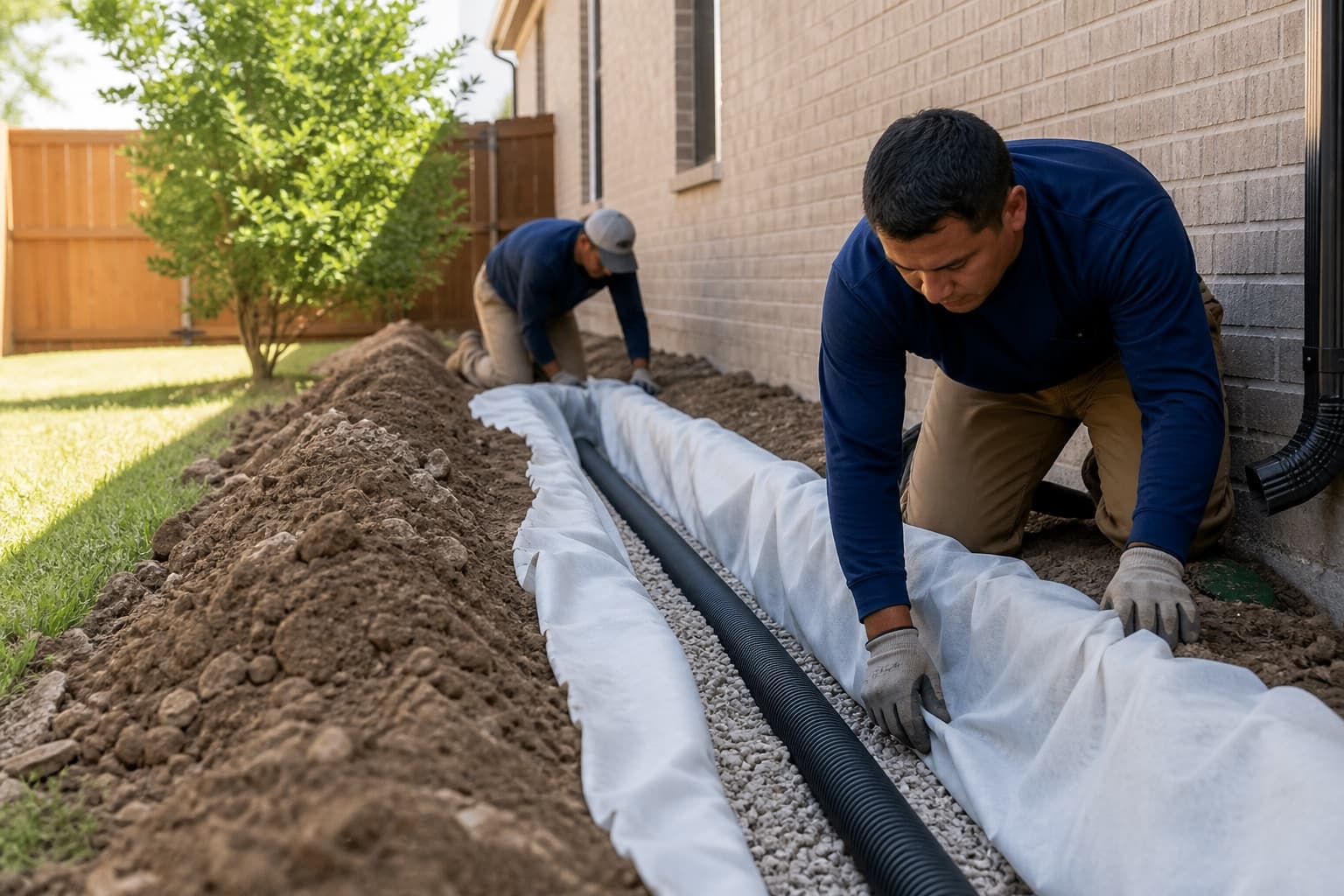
Subsurface collection may fit a recurring saturated route. The trench, filter, aggregate, perforated pipe, outlet, roots, utilities, and restoration must be designed as a complete system.
Where a lowered patio, driveway, or walk blocks flow, the Lewisville concrete leveling evaluation can clarify whether changing the slab relationship should accompany drainage work.
French drain installation in Lewisville: collection, route, and outlet
The value of a French drain depends on collecting the right subsurface water and having somewhere lower, stable, and authorized to discharge it.
Distinguish saturation from visible runoff
A filtered perforated system targets water within soil. Roof flow, surface sheets, irrigation leaks, plumbing, and water trapped on paving may need different collection or specialist work.
Choose a route around constraints
Trench alignment must account for utilities, roots, fences, pool features, irrigation, walls, neighboring improvements, and the need to restore occupied landscapes.
Build a protected collection assembly
Depth, washed aggregate, filter separation, perforated pipe placement, and surface finish are matched to the observed wet zone and maintenance expectations.
Verify downstream rights and elevation
An association feature, common swale, alley, street, or lake-oriented corridor is not automatically an approved outlet. Ownership, rules, fall, and erosion protection require confirmation.
Provide observation and service points
Cleanouts and visible discharge help the owner distinguish normal operation from blockage, sediment, or a changed downstream condition after installation.
Lewisville drainage repair concerns in established and newer settings
A wet area is classified by source, timing, and route before a contractor recommends collection or excavation.
Standing water behind fences or landscape borders
Surface flow may reach a barrier and spread across a low yard. Restoring grade, adding a surface inlet, or changing the barrier may be more appropriate than subsurface collection.
Roof runoff overwhelming side yards
Large roof sections and combined downspouts can deliver more water than a narrow grass route can carry. Solid pipe capacity, cleanouts, fall, and a stable outlet should be evaluated as one system.
Saturated soil along downhill boundaries
Persistent moisture may move through soil from an uphill area, irrigation, or concentrated discharge. French drain suitability depends on confirming that route and locating a lower discharge elevation.
Runoff redirected by patios and driveways
Hardscape can create a dam, shed water into beds, or form a low point after settlement. Surface collection and concrete adjustment may need to be compared instead of routing around the slab by default.
Erosion at outlets or sloped areas
Concentrated flow can carry soil and mulch downhill. A complete solution manages velocity, protects the discharge, and avoids sending sediment toward a neighbor or shared area.
Source-to-outlet inspection
Lewisville drainage system installation planning process
The evaluation organizes several possible water zones and responsibility boundaries into a clear, maintainable proposal.
1
Document weather and timing
Photos, storm intensity, ponding duration, irrigation schedules, pool use, and dry-weather moisture help distinguish independent sources.
2
Map collection zones
Roofs, downspouts, lawns, beds, drives, patios, retaining features, neighboring grades, and low points are divided into sources that can or cannot share a route.
3
Measure route and outlet
Foundation clearance, available fall, gates, utilities, roots, walls, paving, easements, community boundaries, and maintenance access are compared.
4
Select the least complicated effective system
Grading, surface drains, downspout lines, French drains, and concrete coordination are weighed according to the evidence rather than combined unnecessarily.
5
Explain responsibilities and exclusions
The proposal identifies work limits, restoration, outlet, maintenance, and separate association, municipal, engineering, plumbing, pool, electrical, or structural needs.
Related, not interchangeable
Foundation drainage in Lewisville is site context, not a diagnosis
Managing water near a structure can be appropriate, but foundation conclusions require evidence from the building and cannot be promised through drainage work.
Moisture sources are separated
Stormwater, irrigation, plumbing, condensate, pool activity, and subsurface flow can overlap. The drainage scope should be tied to the verified source.
Structural observations use another record
Floor measurements, cracks, doors, windows, exterior joints, additions, and prior repairs organize the foundation evaluation independently from wet-yard observations.
Settled flatwork may change water paths
Patios and walks can create low points without proving foundation movement. Their elevations are considered through the concrete service while drainage work addresses collection and discharge.
No system guarantees future soil response
A drainage installation can be monitored for capture and outlet performance. It cannot guarantee how soil moisture or a foundation will behave over time.
Lewisville drainage and French drain installation cost factors
A property-specific estimate reflects collection zones, route length, excavation, access, hardscape, outlet work, and restoration. Community name and lake proximity are not pricing factors by themselves.
Multiple downspouts, basins, cleanouts, branches, trench zones, and fittings can affect materials and installation time.
Access and concealed conflicts
Fences, roots, utilities, irrigation, pool systems, walls, and narrow routes can require hand excavation, protection, or redesign.
Crossings and site restoration
Driveways, walks, patios, sod, beds, decorative landscapes, and irrigation should be addressed explicitly in the scope.
Outlet and shared-system questions
Emitters, erosion control, pumps, electrical service, common features, easements, and approvals can affect design and remain separate when not included.
Before the visit
Prepare for a Lewisville drainage evaluation
Current observations and information about property improvements help distinguish several potential water routes.
01
Take safe photos of each wet zone, downspouts, hardscape, slopes, inlets, emitters, and visible discharge during and after rain.
02
Record whether water also appears with irrigation, pool operation, condensate, plumbing use, or otherwise dry conditions.
03
Gather dates for pools, patios, additions, replacement paving, utilities, walls, grading, and landscape changes.
04
Identify private, association, public, or neighboring features that may affect responsibility or access.
05
Locate known cleanouts, emitters, irrigation, and private utility routes without excavating.
Continue your research
Lewisville drainage guides and nearby service areas
Use educational resources to prepare questions, then rely on property observations and measurements for the recommendation.
Does lake proximity mean a Lewisville yard needs a French drain?+
No. Geographic proximity does not establish soil saturation or groundwater behavior at a home. The actual water source, grade, soil route, and outlet must be evaluated.
Can Castle Hills drainage connect to a community system?+
Do not assume it can. Private and association responsibilities, governing documents, easements, elevations, and connection rules should be verified before relying on a shared feature.
What is best for standing water behind a fence?+
The answer depends on whether the water is surface runoff, roof discharge, irrigation, or subsurface moisture and whether a lower outlet exists. Grading, an inlet, solid pipe, or a French drain may be compared.
Can drainage and concrete leveling be completed together?+
They can be coordinated when slab elevations affect the water route, but each scope should identify its own objective, method, pricing, and limitations.
Will drainage work fix foundation movement?+
Drainage work can manage identified exterior water. It does not repair a foundation or guarantee future structural response. Foundation concerns require a separate inspection.
What affects French drain cost in Lewisville?+
Trench length and depth, filter and aggregate design, access, roots, utilities, hardscape, outlet construction, restoration, and shared-system requirements influence cost.
What is reviewed during the free drainage evaluation?+
The visit reviews reported timing, visible sources, grades, paving, collection points, route constraints, outlets, and related observations. Installation, testing, engineering, and approvals are separate.
How should a drainage system be maintained?+
Maintenance depends on design but may include clearing gutters, inlets, cleanouts, and outlets; observing emitters; managing sediment and roots; and correcting erosion or landscape changes that obstruct flow.
Free drainage evaluation
Schedule a Free Drainage Evaluation in Lewisville
Tell us which areas remain wet, when the condition appears, and how roofs, grades, hardscape, community boundaries, or lake-oriented terrain shape the route.