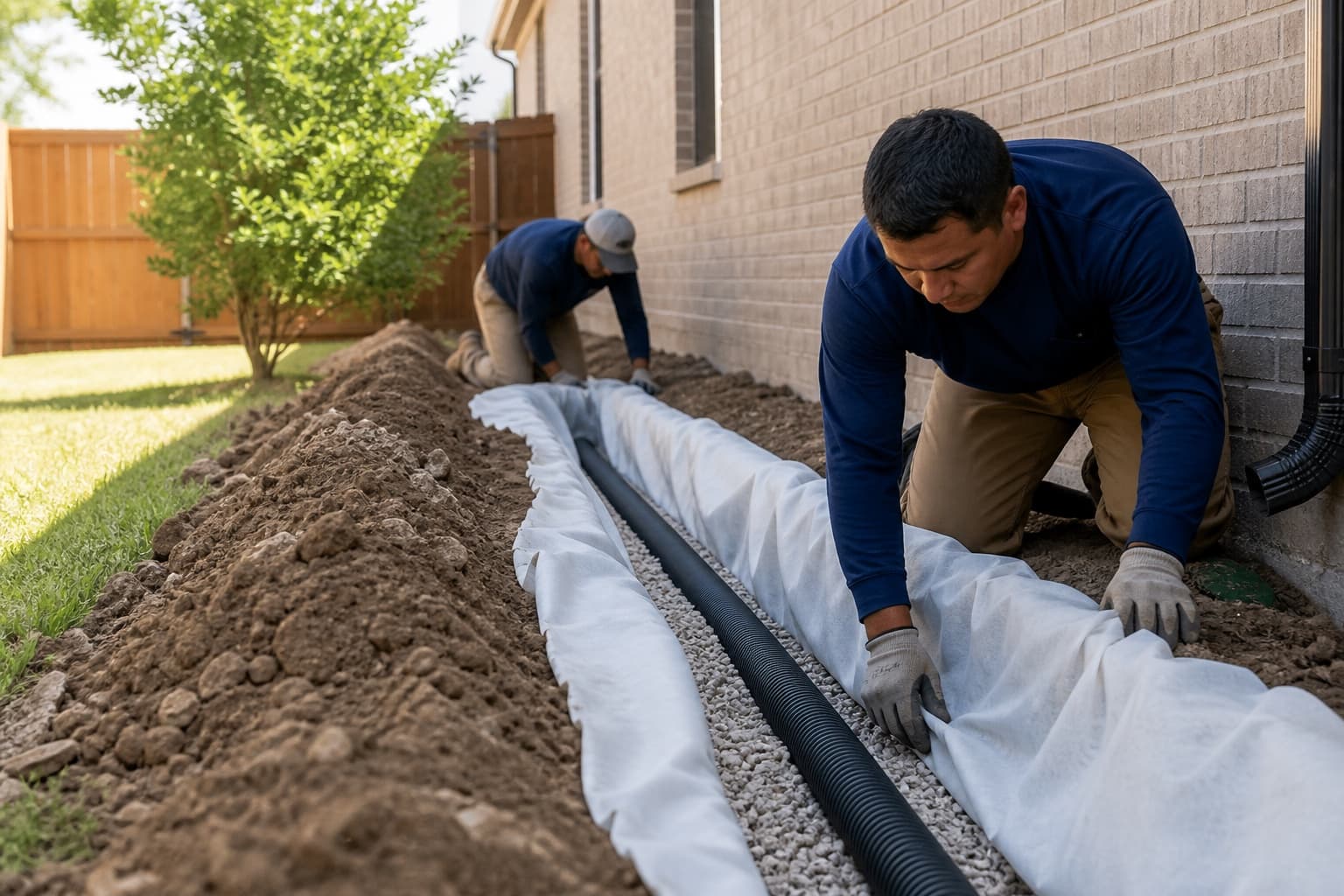
Keller yard drainage, grading, and French drain evaluation
Drainage Company in Keller, TX | French Drain Installation
Schedule a free drainage evaluation with a drainage company in Keller for standing water, downspout routing, erosion, grading, and French drain installation tailored to the individual lot.
A drainage company in Keller should identify whether water is moving across the surface, remaining in saturated soil, or arriving from a concentrated source. A low backyard may collect runoff from an uphill lawn, while a wet side yard may be fed by downspouts, irrigation, or a blocked route. French drain installation is one possible response to subsurface water, not a universal fix for every Keller drainage concern.
Hidden Lakes, Marshall Ridge, Old Town Keller surroundings, and established neighborhoods near Keller Town Center offer different lot shapes, grades, tree cover, and hardscape patterns. Larger properties may also include detached garages, pools, long driveways, or multiple roof areas. Neighborhood references help frame the visit while the recommendation remains tied to measurements and water behavior at the address.
Drainage can affect moisture near a foundation or support beneath exterior concrete, but the visible water does not diagnose either system. Foundation movement requires its own inspection evidence, and a settled driveway or patio may need a separate concrete evaluation. The free drainage visit defines the water-management scope and identifies when coordination with another service is appropriate.
City-specific context
Keller drainage routes vary across planned communities, rolling lots, and established streets
Hidden Lakes, Marshall Ridge, central Keller, and larger residential properties can present distinct grading and outlet constraints. No community name determines the correct system.
01
Hidden Lakes
Planned neighborhoods may include greenbelt or golf-course relationships, pools, patios, broad roofs, and common drainage features. The inspection confirms private responsibility and the usable downstream connection before relying on a shared swale or inlet.
02
Marshall Ridge
Rolling streets and newer landscape improvements can create high-side runoff, low-side collection, walls, and long side-yard paths. Source control and outlet planning should precede selection of a French drain or surface system.
03
Old Town Keller and nearby established streets
Older lots can include mature trees, additions, varied drive and walk elevations, and drainage components installed at different times. Existing routes should be located before a new line is added.
04
Larger residential properties
Detached structures, long irrigation zones, pools, driveways, and several roof areas can create independent water sources. Dividing the property into manageable drainage zones may be more effective than forcing every source into one system.
Method follows the water path
Keller yard drainage solutions and drainage system installation
The selected components should correspond to observed water and remain accessible for inspection and maintenance.
01
Grading and swale correction
A targeted grade adjustment may restore surface flow where enough space and fall exist. Foundation clearances, walls, roots, utilities, neighboring elevations, and erosion protection must be considered.
Roof water can be moved through solid pipe when connections, capacity, cleanouts, slope, and discharge are suitable. A buried pipe should not become an invisible dead end.
Visible runoff can be captured at a defined low point with a basin or channel. Grate elevation, debris, traffic, pipe route, outlet, and cleaning access affect long-term usefulness.
A filtered aggregate trench with perforated pipe may collect water moving through saturated soil. Alignment, depth, filter compatibility, roots, utilities, fall, outlet, restoration, and cleanouts should be specified.
A sunken walkway, driveway, or patio can redirect water or expose slab support at an edge. Concrete leveling is a separate repair path, and proposed elevations should be coordinated with drainage when the two conditions connect.
French drain installation in Keller: suitability, route, and outlet
French drain installation in Keller should follow evidence of subsurface-water movement. The system needs a collection area, practical trench route, compatible filter assembly, sufficient conveyance, stable discharge, and a maintenance plan. A wet yard alone does not establish those conditions.
Observe how long saturation remains
Water that persists after surface flow ends can support further subsurface review. Irrigation schedules, downspouts, leaks, and shaded soil should be considered because they can prolong wetness for different reasons.
Select a buildable alignment
The trench should intercept the wet route while protecting foundations, roots, utilities, irrigation, fences, walls, paving, pools, and access. The shortest line is not always the most appropriate.
Specify the collection assembly
A useful proposal describes trench dimensions, filter separation, aggregate, perforated pipe, connections, cleanouts, and restoration. Material choices should fit the site rather than rely on a generic drain label.
Establish conveyance and discharge
Adequate slope or another designed method must carry water from the trench. The outlet should be protected from erosion, observable, and consistent with verified boundaries and requirements.
Provide service access
Cleanouts and outlets should remain reachable after landscaping is restored. Sediment, roots, damaged fittings, and blocked discharge can reduce performance over time.
Keller drainage repair concerns to evaluate before installation
The appearance of water at one low point does not reveal where it began. The evaluation follows the sequence from source through collection to discharge.
Surface runoff crossing a sloped yard
Water may move from uphill lawns, drives, or neighboring grades before collecting near the home. Swales, grading, barriers, and erosion should be reviewed before a subsurface drain is proposed.
Downspouts ending near foundations or walks
Roof discharge can saturate beds, cross sidewalks, or enter low side yards. A solid conveyance route needs adequate fall, capacity, cleanouts, and an outlet that will not cause erosion or nuisance flow.
Persistent wet soil after runoff disappears
Slow-draining soil may support a French drain evaluation, but irrigation, plumbing, condensate, and roof water should be ruled out or coordinated first. The saturated zone and its outlet must be identifiable.
Water trapped by patios and driveways
Hardscape, edging, and walls can interrupt shallow drainage. Surface inlets, concrete adjustment, or a changed landscape route may be more direct than a perforated trench when the water is visibly flowing on top.
Erosion at discharge points
Bare channels, displaced mulch, exposed roots, or sediment below an outlet show concentrated energy. Collection must be paired with stable discharge and velocity control.
Related, not interchangeable
Keller foundation drainage and exterior-concrete considerations
Site water, building movement, and flatwork settlement can share context without proving one another or requiring the same repair.
Foundation moisture is evaluated by area
Roof size, shade, irrigation, paving, and grade may differ around the perimeter. A wet section should be tied to its source and route rather than generalized across the building.
Concrete can redirect water
A lowered drive, walk, or patio may hold runoff or direct it toward a wall. Drainage and concrete recommendations can be coordinated while preserving separate scopes and repair limits.
Dry-weather water needs another explanation
Irrigation, plumbing, pool equipment, and condensate can resemble rain drainage. Appropriate testing may be needed before a surface or subsurface system is installed.
Foundation repair is not selected from drainage symptoms
Ponding does not establish structural movement or repair need. A foundation evaluation uses building evidence and measurements, even when water management is also recommended.
How a Keller drainage company evaluates system installation
The free evaluation turns observations into a source-to-outlet plan and defines which components have a clear purpose.
1
Establish the timing pattern
The evaluator asks what kind of rain produces the issue, how quickly water arrives, how long it stays, and whether irrigation or dry weather creates similar moisture. Photos help document peak conditions safely.
2
Trace each input
Roofs, downspouts, uphill lawns, drives, patios, pools, irrigation, and visible neighboring flow are mapped. Concentrated and broad runoff should not be treated as the same source.
3
Measure routes and constraints
Low points, foundation clearances, walls, beds, fences, roots, utilities, paving, access, and possible outlets are considered together. The chosen route must remain constructible and serviceable.
4
Compare drainage methods
Grading, swales, basins, channels, solid pipe, French drains, outlet protection, and combined measures are compared to the observed surface or subsurface water.
5
Document the operating plan
The scope should explain what water is collected, how it travels, where it discharges, what restoration is included, and how inlets, cleanouts, or outlets are maintained. Separate trades remain identified.
Property-specific scope
Keller drainage repair and French drain installation cost factors
A Keller drainage proposal is based on actual components, access, route, and outlet. The free evaluation defines the system before property-specific pricing is prepared.
A grading correction, one basin, several downspout lines, or a long French drain involves different materials and labor. Each component should be tied to an observed source.
Excavation and access
Roots, utilities, slopes, walls, gates, fences, paving, pools, and landscaped areas can require hand work or protection. Restoration should be described rather than assumed.
Fall, outlet, and controls
Gravity routes depend on elevation and a suitable destination. Outlet stabilization, emitters, tie-ins, pumps, electrical service, or alternative alignments can change the scope and upkeep.
Work outside the drainage scope
Gutters, irrigation, concrete, plumbing, pool systems, landscaping, permits, municipal work, or engineering remain separate unless specifically included. The proposal should make exclusions easy to understand.
Before the visit
Prepare for a Keller drainage evaluation
A simple record of water timing and known property changes is more useful than attempting to select a drain before the visit.
01
Collect safe photos or video of ponding, downspout flow, erosion, inlets, and outlets during and after rain.
02
Note whether irrigation, pool use, condensate, or dry-weather plumbing activity creates similar wet areas.
03
Identify known underground drains, cleanouts, utilities, irrigation, patios, walls, additions, or prior grading work.
04
Clear accessible debris only when safe; do not excavate or enter flooded areas.
05
Mention related foundation or settled-concrete concerns so each service can be evaluated independently and coordinated where appropriate.
Continue your research
Keller drainage guides and nearby service areas
Use educational resources to prepare questions, then rely on property observations and measurements for the recommendation.
Does standing water in a Keller yard require a French drain?+
No. Visible runoff may need grading, a surface inlet, downspout routing, or outlet correction. French drains are considered when subsurface water is verified and a suitable trench and discharge route exist.
Can a French drain collect roof water?+
Roof water is usually conveyed through solid pipe rather than automatically entering a perforated trench. A combined design needs adequate capacity, deliberate connections, and maintenance access.
How do Hidden Lakes or Marshall Ridge affect the recommendation?+
They provide geographic and development context, not a diagnosis. Private grades, shared features, roof water, paving, utilities, outlets, and ownership must still be confirmed for the individual property.
Can drainage work correct a sunken driveway?+
Drainage may address water contributing to erosion or ponding, but it does not raise concrete. A driveway may need separate leveling or replacement evaluation, coordinated with the intended water route.
What affects French drain cost in Keller?+
Trench length and depth, filter and aggregate details, roots, utilities, access, slope, outlet, cleanouts, hardscape crossings, and restoration influence cost. Suitability is determined before pricing the system.
Will drainage correction guarantee foundation performance?+
No. Drainage can manage identified exterior water but cannot guarantee foundation or soil behavior. Structural concerns require separate measurements and property-specific evaluation.
Free drainage evaluation
Schedule a Free Drainage Evaluation in Keller
Tell us where water appears, how long it stays, which roof or uphill areas feed it, and what grading, hardscape, or outlet constraints affect the property.